
4.6 Sound Quality vs SPL Competition
🔰 BEGINNER LEVEL: Two Philosophies
The Fundamental Divide
Car audio competition takes two very different approaches to the question: what makes a system good?
Sound Quality (SQ) competition answers: accurate, natural, musical reproduction — a system that sounds like the musicians are in the car with you.
SPL competition answers: maximum acoustic output at a test frequency — the loudest measured tone wins.
Neither is wrong. They're simply different sports.
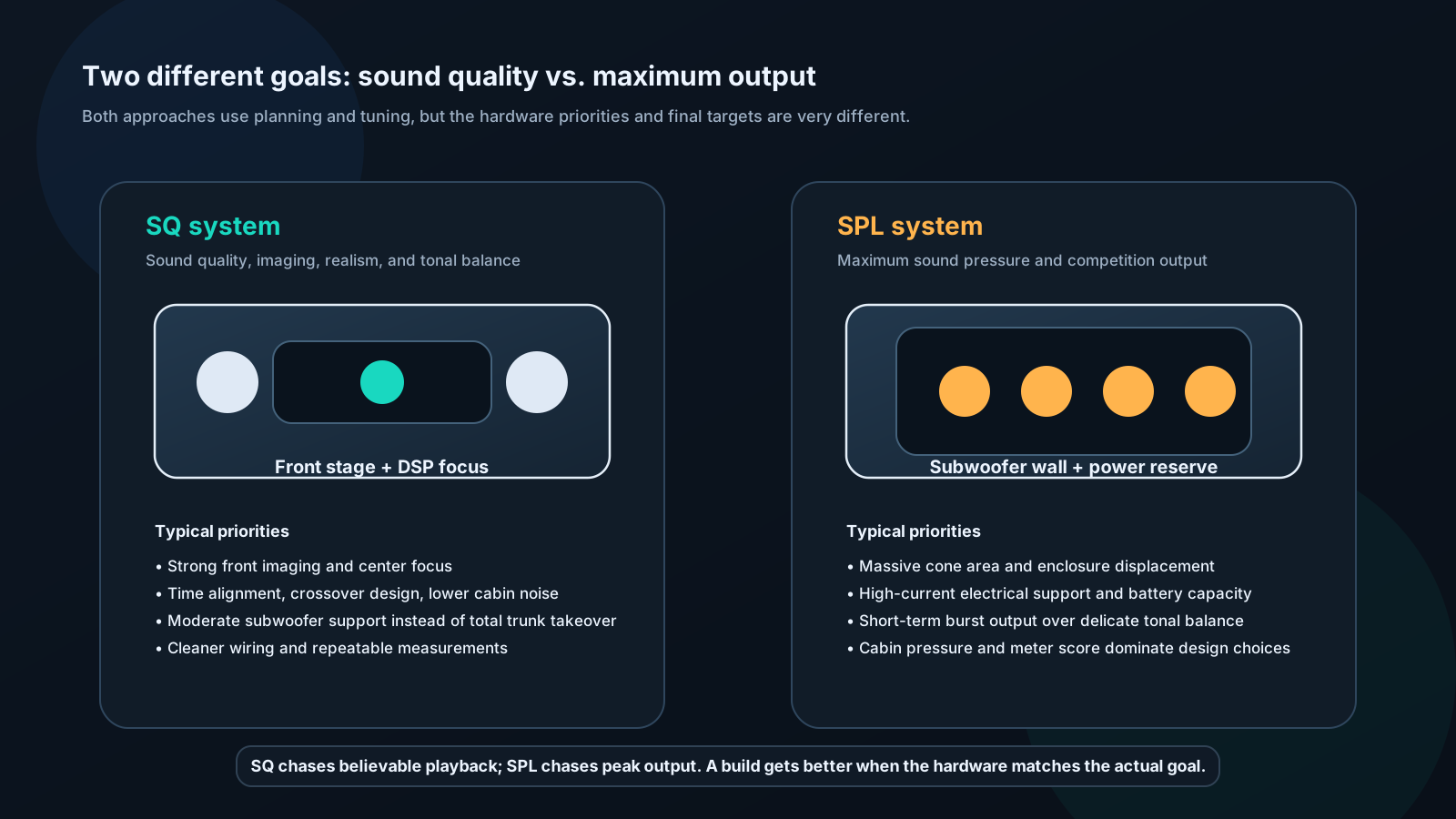
Key differences:
| Aspect | Sound Quality | SPL |
|---|---|---|
| Goal | Accurate reproduction | Maximum output |
| Music played | Full range, all genres | Single test tone |
| Listening position | Driver's ears | Judge's position / outside vehicle |
| Subwoofers | 1–2, musical | 4–24+, tuned to one frequency |
| Power | 500–3,000W | 10,000–100,000W+ |
| Batteries | 1–2 | 8–20+ |
| Typical cost | $2,000–$10,000 | $10,000–$150,000+ |
| Experience | Enjoyable daily | Dangerous without protection |
Which Should You Build?
Build for SQ if: - You drive the vehicle daily - You want to enjoy music - Budget is moderate ($2,000–$10,000) - You care about vocal clarity, soundstage, detail
Build for SPL if: - You want competition trophies - You have a dedicated vehicle - You have an unlimited electrical budget - Pure engineering challenge appeals to you
Build a hybrid if: - You want the best of both - Budget is $5,000–$20,000 - You can tune between "music" and "demo" modes - You attend shows but also drive the vehicle
🔧 INSTALLER LEVEL: Competition Categories and Judging
Sound Quality Judging Criteria
This page is meant to include a finished diagram or annotated reference visual. The final asset is not published yet.
Planned visual: Sample IASCA/MECA SQ scorecard showing scoring categories, point values, and judge notes fields
IASCA (International Auto Sound Challenge Association) SQ categories:
1. Imaging and Soundstage (30 points)
- Phantom center: Vocalist appears at center, not biased left or right
- Stage width: Sound extends at least to dashboard edges, ideally beyond A-pillars
- Stage height: Sound appears at dash height or above (not from floor or doors)
- Stage depth: Front-to-back layering — front elements forward, reverb trails back
- Image stability: Image stays locked as volume changes
How to optimize:
- Time alignment precise to 0.1 ms
- Level matching between L and R to 0.5 dB
- Tweeter placement at ear height or above
- Minimal reflections from windshield (damping or absorption)
2. Tonal Accuracy (25 points)
- Does the system reproduce spectral balance accurately?
- Does the bass have impact without boom?
- Are vocals natural and uncolored?
- Is treble extended without harshness?
Judges use reference recordings they know deeply. They listen for whether the system sounds like the recording or like "a car stereo."
How to optimize:
- Flat frequency response relative to target curve (not boosted bass)
- Low distortion at reference listening level
- Smooth crossovers with no dip or peak at transition frequency
- Subwoofer integrates seamlessly (listener can't localize it)
3. Detail and Resolution (20 points)
- Can you hear reverb trails clearly?
- Are subtle background elements audible?
- Is there a sense of "air" around instruments?
How to optimize:
- Low noise floor (no alternator whine, no hiss)
- Clean amplification (quality components, proper gain)
- High signal-to-noise ratio throughout chain
4. Dynamics (15 points)
- Does the system track transients accurately?
- Is there contrast between loud and soft passages?
- Does bass impact feel physical and controlled?
How to optimize:
- Sufficient headroom (no clipping at peaks)
- Adequate power for clean transients
- Subwoofer with good transient response (sealed preferred)
5. Overall Musicality (10 points)
- Subjective catch-all
- Does the system draw you into the music?
- Is listening fatiguing or pleasurable?
This is where taste meets technical excellence.
SPL Competition Categories
dB Drag Racing classes (example — rules vary by organization):
By vehicle type: - Street class: Must be street-legal, factory-installed glass - Modified: Significant vehicle alterations allowed - Extreme: Dedicated competition vehicles, any modification
By driver type: - Single driver: One subwoofer - Multiple drivers: 2, 4, or more
By test frequency: - Bass race: Competitor chooses frequency (50–65 Hz typical) - Fixed frequency: Organization sets frequency (e.g., 40 Hz, 50 Hz)
Scoring:
Single measurement at specified mic position (usually A-pillar area, or outside vehicle for termlab events). Highest dB wins. Simple.
MECA (Mobile Electronics Competition Association):
Separate SQ and SPL divisions with their own classes. SPL uses a handheld termlab meter. SQ uses live judging.
Building for SQ Competition
This page is meant to include a finished diagram or annotated reference visual. The final asset is not published yet.
Planned visual: Interior photo of award-winning SQ build showing clean component speaker installation, discrete wiring, professional fabrication at dash and doors
Component selection:
Tweeters: - Silk dome preferred (smooth, natural) - 25–28mm size - Low Fs (< 800 Hz) for low crossover option - Brands: Scan-Speak, Focal, Seas, ScanSpeak
Midrange: - 3–4 inch preferred - Low coloration, flat response - Smooth off-axis response - Brands: Seas, Morel, Peerless
Midbass: - 6.5–7 inch - Well-controlled - Sealed enclosure preferred - Brands: Focal K2, Morel Supremo, SB Acoustics
Subwoofer: - 10–12 inch typically - Fast, accurate — not loud - Sealed enclosure - Low Qts (0.4–0.5) for accuracy
Amplifiers: - Low noise floor is critical - Class AB preferred for SQ (lower residual noise than Class D) - High damping factor (>200) - Brands: Audison, Mosconi, Brax, Hertz
DSP: - Most comprehensive available - FIR linear-phase capability preferred - Full parametric EQ (10+ bands) - Fine time alignment (0.01 ms resolution)
Installation:
SQ judges score installation as part of overall presentation: - All wiring hidden or loomed - No visible RCA cables - Symmetrical placement of components - Professional fabrication of speaker baffles and pods - Clean treatment of all surfaces
Building for SPL Competition
This page is meant to include a finished diagram or annotated reference visual. The final asset is not published yet.
Planned visual: Trunk of SPL vehicle showing wall of 12 subwoofers facing rearward, massive amplifier rack, battery bank, with safety warnings visible
Driver selection:
The most critical choice in SPL:
- High sensitivity (92–96 dB @ 1W/1m)
- Large motor, high Bl
- Designed for bandpass loading
- Multiple drivers — 4, 8, or more
Enclosure:
Bandpass tuned to within 2 Hz of test frequency. Every Hz off costs output.
- Sealed rear chamber: 0.7–1.0 × Vas
- Ported front chamber: 1.5–2.0 × Vas
- Port: Large area, length tuned exactly
- Construction: Minimum 1.5" MDF, braced aggressively
Setup for test day:
- Measure box resonance with sine sweep
- Fine-tune port length if off-target
- Set amplifier gains maximally (within thermal limits)
- Test with competition meter before official run
- Close all windows, doors, vents
- Double hearing protection — always
âš™ï¸ ENGINEER LEVEL: Advanced Competition Optimization
SQ — Phase Coherent Crossover Design
The challenge:
At the crossover frequency, two drivers overlap. Their relative phase determines whether they add or subtract.
For flat acoustic sum:
Linkwitz-Riley criterion: - At crossover: each driver -6 dB - Phase difference: 360° (equivalent to 0°, constructively sums)
Verified by measurement:
- Measure tweeter with HPF active, midbass silent
- Measure midbass with LPF active, tweeter silent
- Both should be -6 dB at crossover
- Enable both → should measure flat (0 dB) at crossover
If not flat:
- Phase inversion needed: Flip tweeter polarity
- Delay needed: One driver arrives early — add time delay
- Different slope order: Mismatched slopes cause non-360° difference
Minimum-phase crossovers in practice:
All-pole analog crossover topologies (Butterworth, Bessel, LR) are minimum phase. Their phase response tracks their magnitude response via the Hilbert transform.
Implication: You cannot independently set magnitude and phase in an IIR crossover. Setting the crossover frequency determines both.
FIR crossovers offer a solution:
A symmetric FIR filter has linear phase — constant group delay at all frequencies. Two FIR crossover filters that are perfectly complementary (HPF + LPF = 1) will sum flat and have matching delays. No phase artifacts.
Cost: Significant filter length (512–2048 taps typical) and DSP computational resources.
SPL — Acoustic Efficiency Optimization
Net acoustic power:
P_acoustic = η × P_electrical
Where η = radiation efficiency.
For a conventional driver in an enclosure:
η = (Ïâ‚€ × Bl² × Sd²) / (2Ï€ × Mms² × Re × c)
Maximizing η:
- Bl: Strong motor — large magnet, long winding in gap
- Sd: Large cone area (larger diameter)
- Mms: Lightweight cone — carbon fiber, thin paper, aluminum
- Re: Low DC resistance — thick wire, aluminum former
Competing constraints:
- Low Mms → higher Fs (harder to tune to 40-50 Hz)
- High Bl → heavier motor (increases Mms)
- Large Sd → heavier cone (increases Mms)
Practical optimization:
Competition drivers balance these parameters for maximum efficiency at the target frequency in the specific enclosure. This is why competition drivers are not interchangeable with music drivers — they're optimized for a single operating point.
Cabin loading factor:
SPL_cabin = SPL_free + 20 × logâ‚â‚€(c / (ω × V^(1/3)))
Where V = cabin volume.
Smaller cabin = more pressure build-up = higher SPL for same acoustic power.
Competition vehicles:
- Windows sealed (no air leaks)
- Vents blocked
- Extra panels added (reducing volume)
- Roof lowered (reducing volume)
Some competitors go to extreme lengths — fiberglass enclosures replacing rear seat, custom dash panels, anything to reduce cabin volume while maintaining seal integrity.
The 1/3-octave bandwidth effect:
Test frequency must be measured within ±0.5 Hz of target. Competition meters (TermLab) use a 1/3-octave band filter. System must be tuned precisely or output is split between two measurement bands.
Precise tuning procedure:
- Play sine wave at test frequency
- Measure port resonance with TermLab
- If resonance off: Adjust port length (shorter = higher frequency)
- Re-measure
- Iterate until within 1 Hz of target
Temperature compensation:
Speed of sound varies with temperature:
c = 331.4 × âˆš(1 + T/273) m/s
At 20°C: c = 343 m/s At 40°C (summer competition): c = 355 m/s (3.5% faster)
Port tuning frequency shifts with temperature!
Fb ∠c ∠√T
A box tuned to 50 Hz at 20°C will be at ~51.7 Hz at 40°C.
Competition compensation:
Tune box slightly below target at room temperature, knowing it will rise toward target in hot competition conditions. Or design port for quick length adjustment.
END OF CHAPTER 4 — COMPLETE
Chapter 4 Final Statistics: - Word Count: ~43,000 words - Page Equivalent: ~86 pages - Sections: 6 of 6 complete ✅ - Three-tier structure: ✅ Throughout - Supporting visuals continue in linked reference assets