4.5 Advanced DSP Programming
🔰 BEGINNER LEVEL: Understanding DSP Hardware
What DSP Actually Does
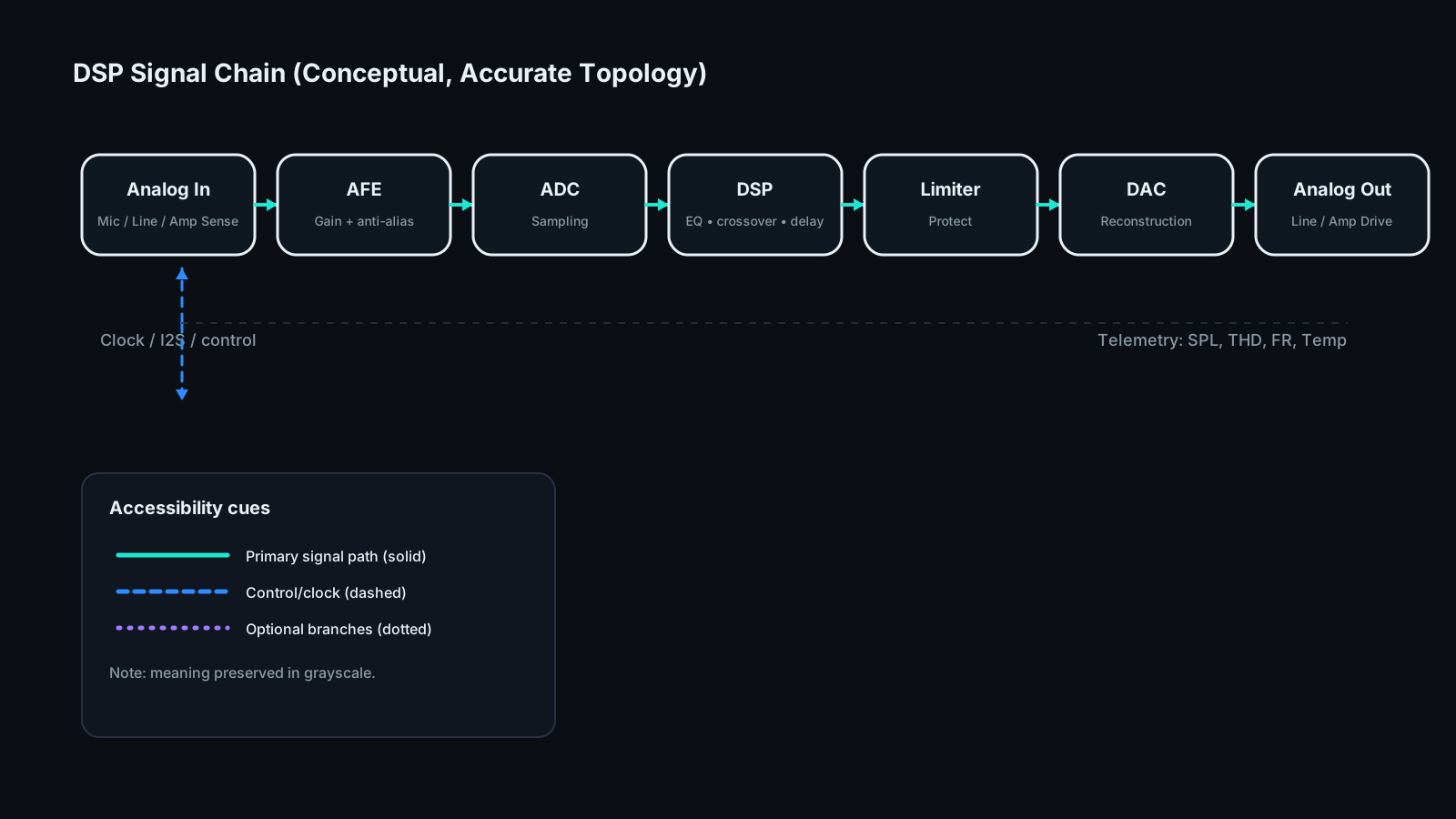
DSP converts your analog audio to digital numbers, processes those numbers with filters, delays, and level controls, then converts back to analog. The processing happens millions of times per second.
Why this matters:
Everything is software — crossover frequencies, EQ bands, time delays, output routing. Change a value in software, and it's instantly and repeatably applied. No component drift. No aging. No manual re-soldering.
Common DSP Products in Car Audio
Entry-level (basic crossovers + EQ):
- JL Audio FiX 86 — Factory integration focus, 8-channel, $300
- AudioControl LC-6i — 6-channel output, bass restoration, $230
- Stetsom DSP6 — 6-channel, budget-friendly, $80
Mid-range (full featured, measurable):
- miniDSP 2×4 HD — 2 in / 4 out, USB computer programmable, $100
- Helix DSP Mini — 6-channel, excellent filters, $280
- AudioControl D-6.1200 — Amp + DSP combo, 6-channel, $550
Professional / Competition:
- miniDSP C-DSP 8×12 — 8 in / 12 out, Dirac Live compatible, $650
- Helix DSP Pro — 6 in / 10 out, FIR capable, $900
- Alpine Bit One — 9-channel, OEM integration, $1,800
Software interfaces vary — miniDSP uses a clean plugin-based interface; Helix uses the powerful IP-Bus connected PC software. All allow saving and loading presets.
Programming a Basic System
Example: 2-way front + subwoofer
Hardware: miniDSP 2×4 HD Speakers: Tweeters (ch 1-2), Midbass (ch 3-4), Subwoofer (ch 5-6, bridged)
Step-by-step:
- Input routing: Stereo input → Ch 1 = Left, Ch 2 = Right
- Output routing:
- Output 1: Left tweeter (from Ch 1)
- Output 2: Right tweeter (from Ch 2)
- Output 3: Left midbass (from Ch 1)
- Output 4: Right midbass (from Ch 2)
- Crossovers:
- Outputs 1-2 (tweeters): HPF at 3,000 Hz, LR24 slope
- Outputs 3-4 (midbass): LPF at 3,000 Hz, LR24 slope; HPF at 80 Hz, LR24 slope
- Outputs 5-6 (subwoofer): LPF at 80 Hz, LR24 slope; Subsonic HPF at 20 Hz
- Delays: Enter calculated delays per output
- EQ: Apply corrections based on measurement
- Output levels: Match via SPL meter
Save as "System v1.0" before experimenting.
🔧 INSTALLER LEVEL: Multi-Input Mixing and Routing
Factory Integration with DSP

Most modern vehicles don't have a preamp output — audio exits the factory head unit as amplified speaker-level signals. Some have active filtering (Bose, Harman, B&W factory systems). A DSP handles this cleanly.
High-level input:
Many DSPs accept 10–50V speaker-level input directly, converting to a usable low-level signal internally. They de-amplify and process simultaneously.
AccuBASS / bass restoration:
Factory head units apply heavy low-frequency rolloff to speaker outputs (often -20 dB or more below 80 Hz). If your DSP feeds from factory speaker outs, you must restore this bass. Most integration-focused DSPs (AudioControl, JL FiX) have automatic bass detection and restoration algorithms.
Channel summing:
A 5.1 or 7-channel factory system may dedicate separate outputs to center, surround, LFE, etc. A DSP can sum these intelligently:
- Left and Center summed → Left front output (with level weighting)
- Right and Center summed → Right front output
- LFE + subwoofer channel → Subwoofer output
Most integration DSPs handle this automatically; advanced units allow manual matrix mixing.
Signal Matrix Mixing
Full mixing matrix:
For a DSP with N inputs and M outputs:
Output_m = Σ(Gain_mn × Input_n) for n = 1 to N
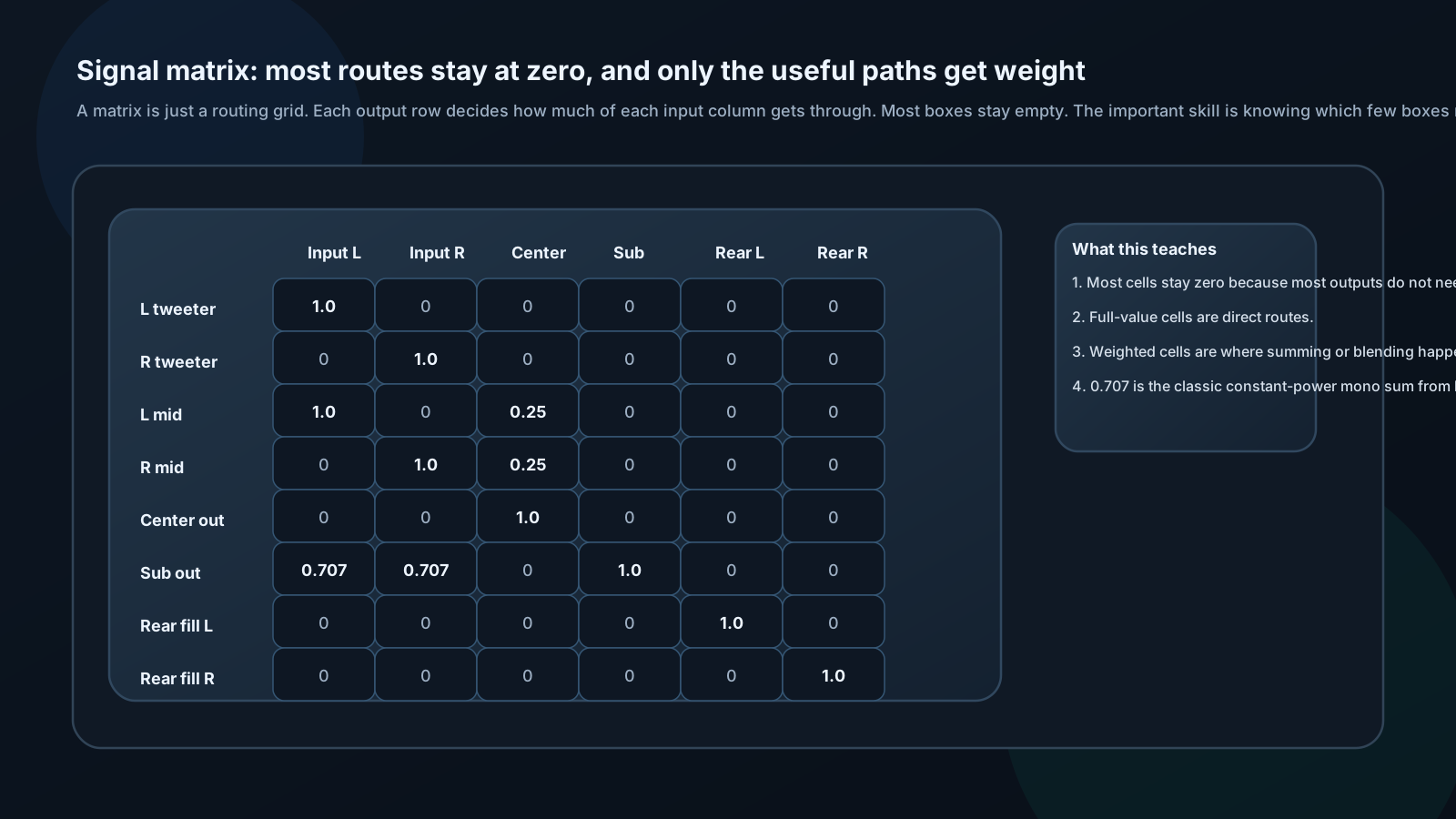
Example 3×4 mix:
| Input L | Input R | Input Sub | |
|---|---|---|---|
| Out 1 (L twt) | 1.0 | 0 | 0 |
| Out 2 (R twt) | 0 | 1.0 | 0 |
| Out 3 (L mid) | 1.0 | 0 | 0 |
| Out 4 (sub) | 0.5 | 0.5 | 1.0 |
Subwoofer receives mono mix of L+R plus dedicated sub signal.
Panning law:
When summing L+R to mono, reduce each by 3 dB to maintain constant power:
Gain_L = Gain_R = 1/√2 ≈ 0.707 = −3 dB
Without this correction, mono summed signal will be 6 dB louder than stereo — a jarring jump when switching sources.
Preset Management
Create multiple presets for different scenarios:
Preset 1: Daily Driving (Reference) - Target curve with gentle bass lift - Time alignment enabled - All EQ corrections active
Preset 2: Critical Listening - Flatter target curve - Maximum accuracy settings - Used for evaluating recordings
Preset 3: Party / High SPL - Increased bass shelf - Less time alignment precision - Higher output limits
Preset 4: Competition - Single-frequency optimization - Bypassed EQ except for target frequency - Maximum subwoofer output
Switching: Via DSP remote, Bluetooth app, or physical input on some units.
Documentation discipline:
Every time you change a preset, note: - Date and what was changed - Why it was changed - What measurement or listening test prompted it
This discipline prevents getting lost after experimentation. A change log is invaluable for troubleshooting.
âš™ï¸ ENGINEER LEVEL: IIR and FIR Implementation
Biquad IIR Filter Mathematics
Every parametric EQ band, crossover section, and shelf filter in a DSP is typically a biquad (second-order) IIR section.
Transfer function:
H(z) = (bâ‚€ + bâ‚zâ»Â¹ + bâ‚‚zâ»Â²) / (1 + aâ‚zâ»Â¹ + aâ‚‚zâ»Â²)
Difference equation:
y[n] = bâ‚€x[n] + bâ‚x[n-1] + bâ‚‚x[n-2] − aâ‚y[n-1] − aâ‚‚y[n-2]
Butterworth HPF coefficients (from bilinear transform):
ω₀ = 2πf_c / f_s
α = sin(ω₀) / (2Q)
b₀ = (1 + cos(ω₀)) / 2
b₠= −(1 + cos(ω₀))
b₂ = (1 + cos(ω₀)) / 2
a₀ = 1 + α
a₠= −2cos(ω₀)
a₂ = 1 − α
Normalize all by aâ‚€.
Parametric peaking EQ coefficients:
A = 10^(gain_dB / 40)
ω₀ = 2πf_c / f_s
α = sin(ω₀) / (2Q)
bâ‚€ = 1 + α×A
b₠= −2cos(ω₀)
bâ‚‚ = 1 − α×A
a₀ = 1 + α/A
a₠= −2cos(ω₀)
a₂ = 1 − α/A
Normalize all by aâ‚€.
SOS cascade:
Higher-order filters use cascaded biquad sections. A 4th-order Linkwitz-Riley is implemented as two cascaded identical 2nd-order Butterworth sections.
Coefficient quantization:
In 24-bit fixed-point DSPs, coefficients have ~7 significant decimal places. Filters with very low cutoff frequencies (relative to sample rate) or very high Q develop coefficients near ±1 — precision is lost and the filter may behave incorrectly.
Solution: Increase sample rate or use double-precision arithmetic for coefficient computation.
FIR Filter Design Workflow
For linear-phase crossovers and room correction curves, FIR filters are required.
Design parameters:
- Target frequency response H_d(ω)
- Sample rate f_s
- Maximum filter length N
- Transition bandwidth Δω
Minimum filter length:
N ≈ (f_s × D_att) / (22 × BW_transition)
Where Datt = desired stopband attenuation in dB, BWtransition in Hz.
Example: 48 kHz system, need 60 dB attenuation with 500 Hz transition at an 80 Hz crossover:
N ≈ (48000 × 60) / (22 × 500) = 261 taps
Parks-McClellan (optimal equiripple) design:
MATLAB: h = firpm(N, [f1 f2 f3 f4], [A1 A2], W)
This produces the shortest filter meeting specs, with equal ripple in passband and stopband.
Linear-phase latency:
FIR filters introduce latency equal to half the filter length:
Latency = N / (2 × f_s)
For 261-tap filter at 48 kHz:
Latency = 261 / (2 × 48000) = 2.7 ms
All channels must have the same (or compensated) latency to maintain alignment.
Mixed-mode processing:
Most commercial car audio DSPs use: - IIR for crossovers and EQ (low CPU, low latency) - FIR for room correction curves (linear phase, higher CPU)
Some premium DSPs (Helix DSP Pro, miniDSP C-DSP) allow user-uploaded FIR coefficients via text file — enabling Dirac Live, REW convolution correction, or custom-designed filters.