
4.1 Understanding Frequency Response and Crossover Settings
🔰 BEGINNER LEVEL: Frequency Response Basics
What is Frequency Response?
Frequency response shows how loud a system plays each frequency.
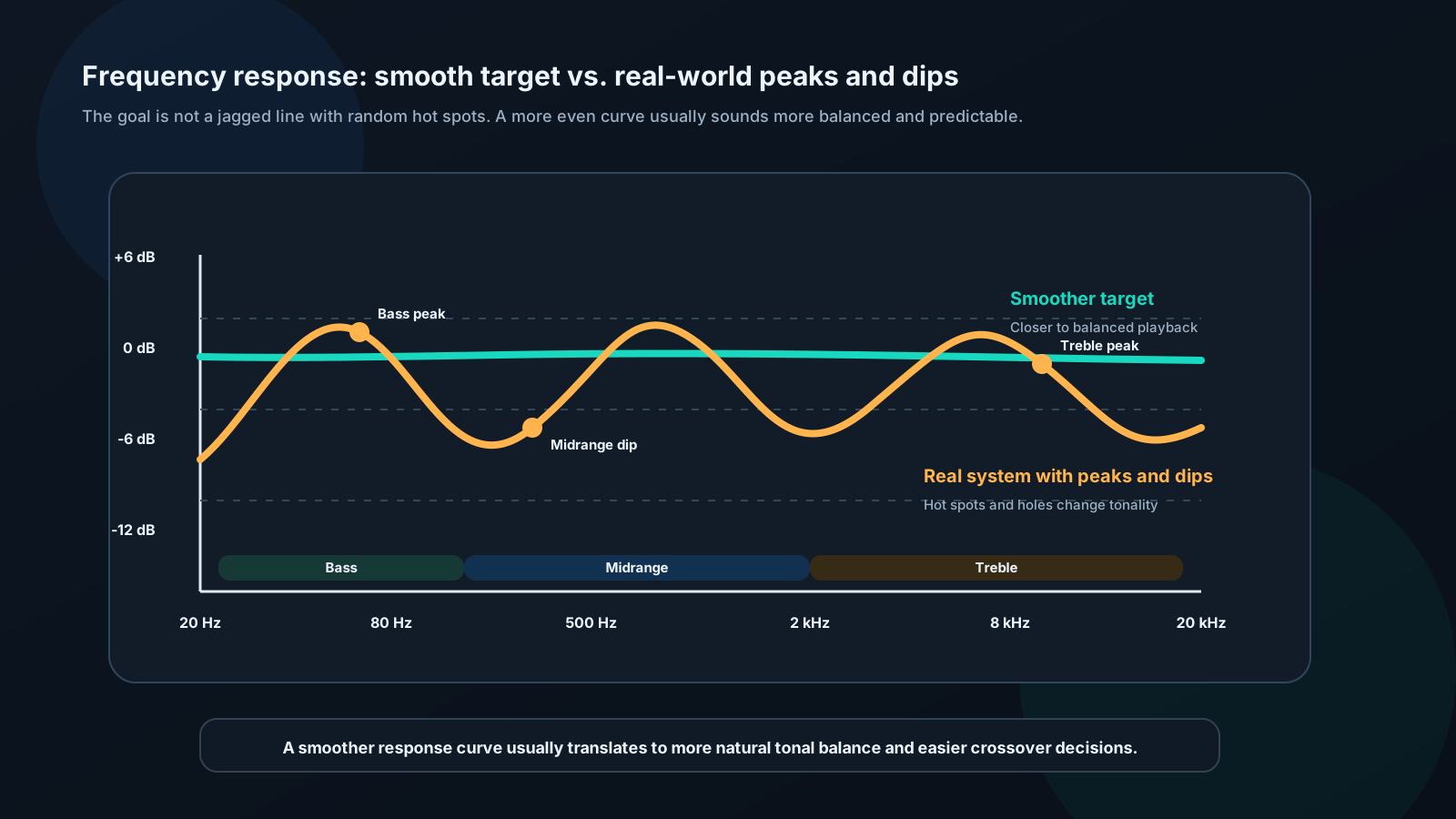
Ideal response: Flat line (all frequencies equal volume) Real systems: Have peaks and dips
Why flat response matters: - Music sounds balanced - Natural tonality - No frequency emphasis/missing - What artist intended
Reading frequency response graphs:
X-axis: Frequency (Hz) - logarithmic scale - 20 Hz (deep bass) to 20,000 Hz (high treble)
Y-axis: Level (dB) - 0 dB = reference - +6 dB = twice as loud - -6 dB = half as loud
Common problems visible: - Peak at 50 Hz: Too much bass - Dip at 3 kHz: Vocals sound recessed - Rolloff above 10 kHz: Lacks sparkle
What Are Crossovers?
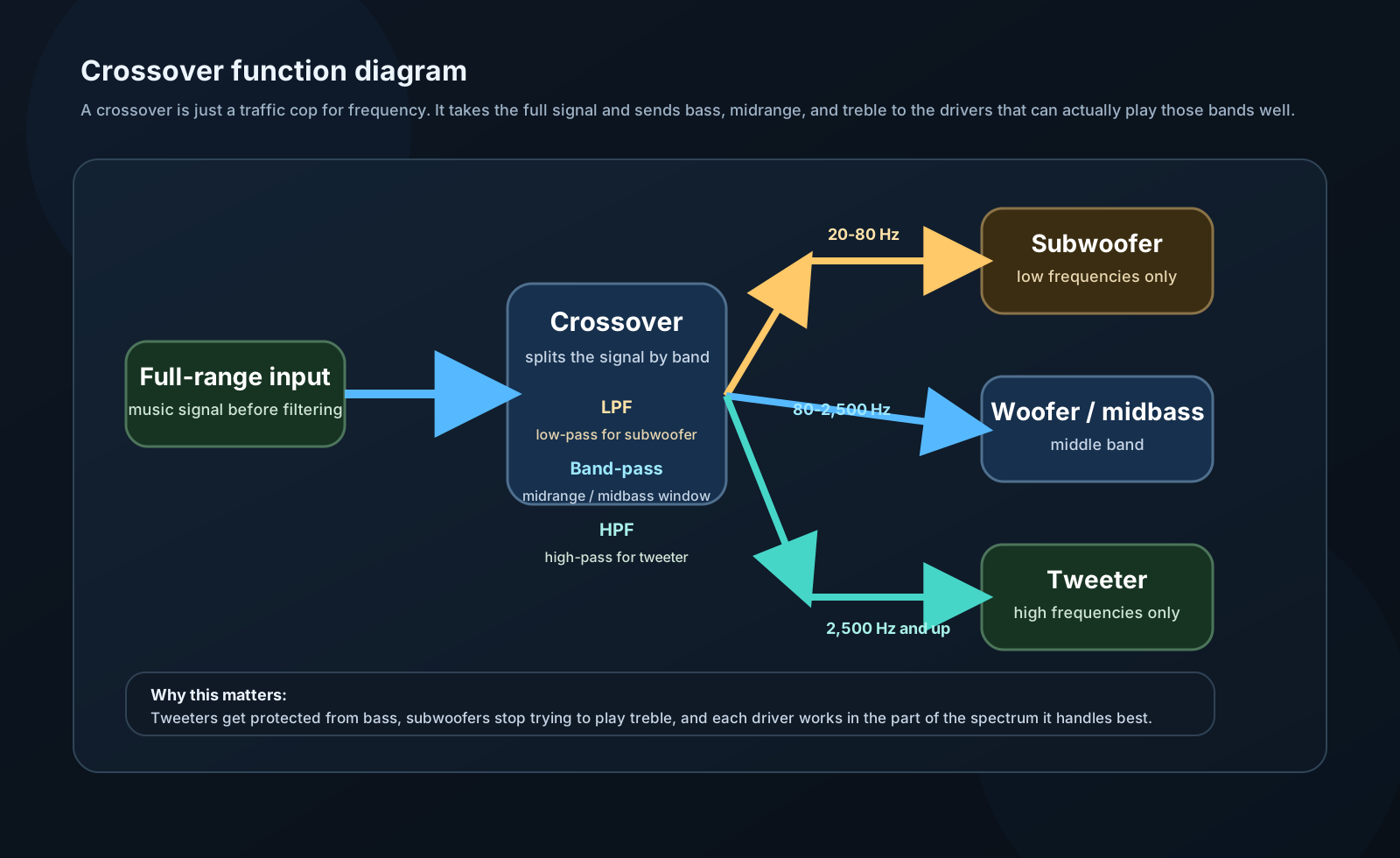
Crossover = Filter that sends specific frequencies to specific speakers.
Why needed:
Tweeters can't play bass - they'll break! Subwoofers can't play highs - they're too slow!
Types of crossovers:
High-pass filter (HPF): - Passes high frequencies - Blocks low frequencies - Used for tweeters and midrange
Low-pass filter (LPF): - Passes low frequencies - Blocks high frequencies - Used for subwoofers
Band-pass filter: - Passes middle frequencies - Blocks highs and lows - Used for dedicated midrange
Crossover Points
Where to cross over?
Rule of thumb: - Subwoofer: 80 Hz (typical for music) - Midbass to midrange: 250-500 Hz - Midrange to tweeter: 2,500-4,000 Hz
Too low crossover: - Speaker tries to play below its range - Distortion - Possible damage
Too high crossover: - Gap in frequency coverage - Thin, unnatural sound
Start with manufacturer recommendations!
Crossover Slope
Slope = How quickly filter attenuates
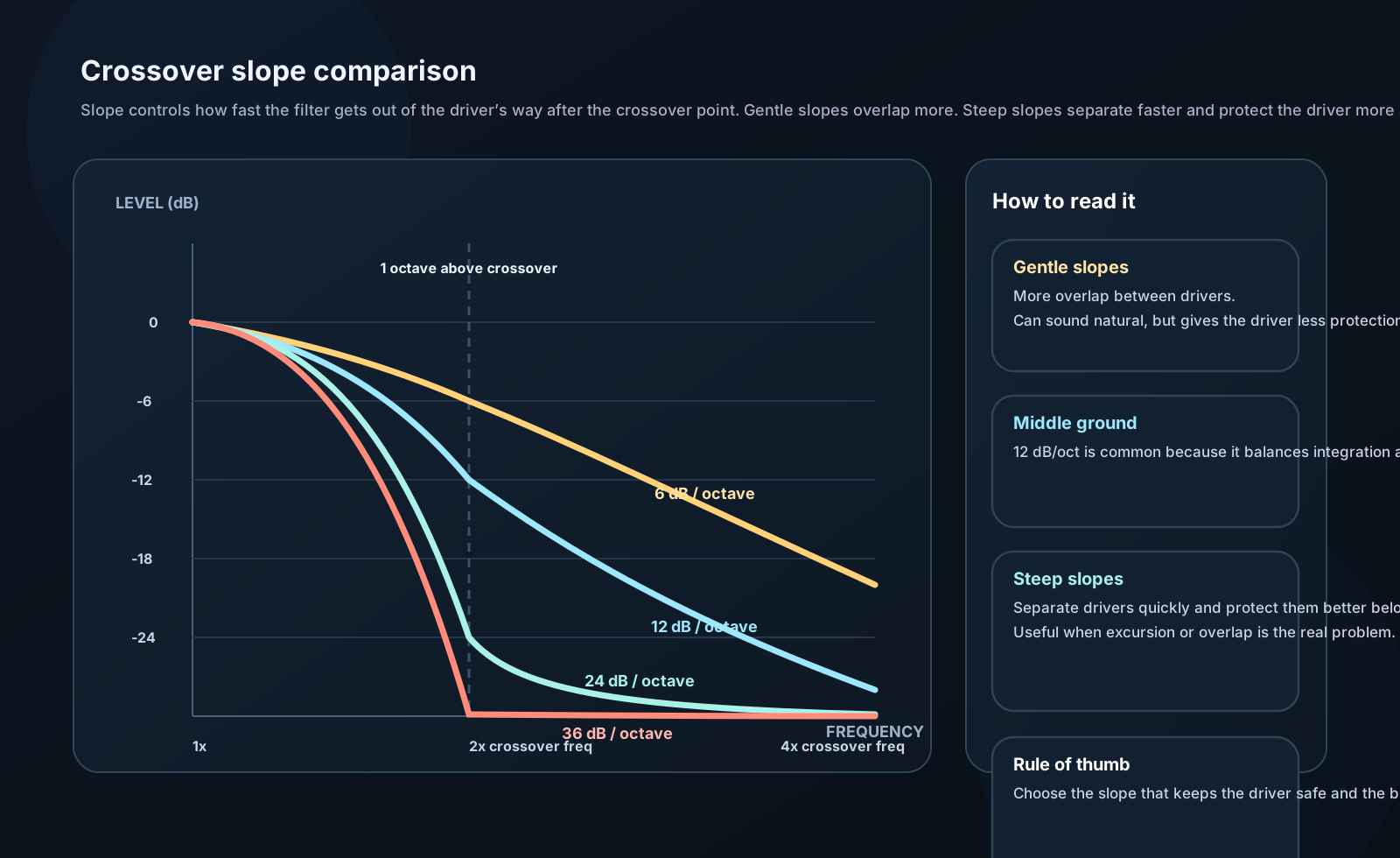
Common slopes: - 6 dB/octave: Gentle, smooth transition - 12 dB/octave: Most common, good balance - 24 dB/octave: Steep, clean separation - 36 dB/octave: Very steep, maximum protection
Steeper slope: - Better speaker protection - Cleaner separation - Less overlap - But can cause phase issues
Gentler slope: - More natural sound - Better integration - More overlap (power handling concern)
🔧 INSTALLER LEVEL: Professional Crossover Configuration
Active vs Passive Crossovers
Passive Crossover:
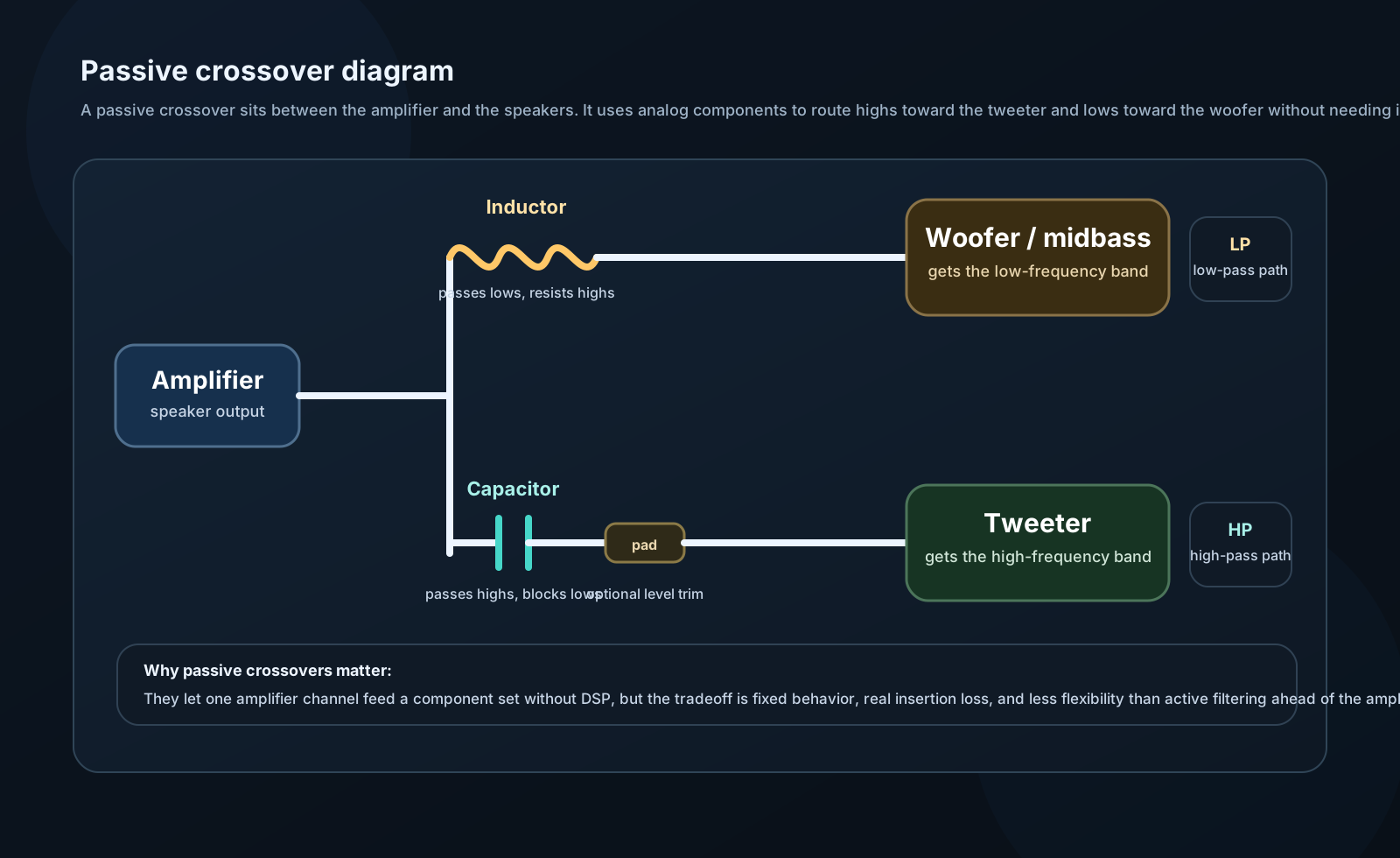
Components: - Capacitors (block lows, pass highs) - Inductors (block highs, pass lows) - Resistors (level adjustment)
Location: Between amplifier and speakers
Pros: - No power required - Simple - Reliable - Included with component speakers
Cons: - Power loss in components (heat) - Fixed frequencies (can't adjust) - Component tolerances (±10-20%) - Interacts with speaker impedance
Active Crossover:
Location: Before amplifier
Types: 1. Built into head unit (basic) 2. Built into amplifier (common) 3. Dedicated DSP (professional)
Pros: - Adjustable frequencies - Adjustable slopes - No power loss - Precise filtering - Time alignment possible (DSP)
Cons: - Requires separate amp channels - More complex - More expensive - Requires tuning
Which to use?
Passive: - Simple systems - Component speakers with included crossovers - Budget builds
Active: - Serious systems - Custom installations - Competition - Maximum performance
Crossover Point Selection Methodology
Step-by-step process:
Step 1: Identify speaker capabilities
Check specifications: - Tweeter: Fs = 1,200 Hz → Cross >2,000 Hz - Midbass: Fs = 80 Hz, Usable to 3,000 Hz
Step 2: Determine overlap region
Where both speakers can play: - Tweeter: 2,000 Hz and up - Midbass: 80-3,000 Hz - Overlap: 2,000-3,000 Hz
Step 3: Choose crossover point in overlap
Considerations: - Lower (2 kHz): - Tweeter plays more range (more output, more distortion risk) - Midrange has less work (better power handling)
- Higher (3 kHz):
- Tweeter protected (less distortion)
- Midrange works harder (possible distortion)
Typical choice: 2,500-3,000 Hz
Step 4: Select slope
For this overlap: - 12 dB/octave: Good starting point - 24 dB/octave: Better if speakers widely separated
Step 5: Listen and adjust
- Too much treble: Raise crossover or lower tweeter level
- Too little treble: Lower crossover or raise tweeter level
- Harsh sound: Steeper slope or raise crossover
- Smooth but weak: Gentler slope or lower crossover
Subwoofer Integration
Subwoofer crossover is critical!
Frequency selection:
Low crossover (50-63 Hz): - Subwoofer only for deep bass - Front speakers carry more bass - Use when: Large front speakers (6.5"+ midbass)
Medium crossover (80 Hz): - Most common choice - THX standard - Good for most systems
High crossover (100-120 Hz): - Subwoofer does all bass work - Protects small front speakers - Use when: Small front speakers, factory integration
Slope selection:
12 dB/octave: - Gentle integration - More overlap with front speakers - Can cause boom if not careful
24 dB/octave: - Clean separation - Most common - Good all-around choice
36 dB/octave: - Very steep - Maximum separation - Good for sound quality - May sound disconnected if not tuned well
Subsonic filter:
Essential for ported enclosures!

Function: - Extreme high-pass filter - Protects subwoofer from over-excursion - Filters infrasonic frequencies (below hearing)
Settings: - Sealed: 20-25 Hz - Ported: 5-10 Hz below tuning frequency
Example: - Box tuned to 32 Hz - Subsonic at 22-25 Hz - Slope: 24 dB/octave minimum
Phase Alignment
Phase = Timing relationship between speakers
In phase: Speakers move together (reinforce) Out of phase: Speakers oppose (cancel)

Phase switch on amplifier: - 0° = Normal - 180° = Inverted
When to invert:
Test by listening: 1. Play bass-heavy music 2. Toggle phase switch 3. More bass: Correct setting 4. Less bass: Wrong setting
Physical explanation:
If subwoofer and front speakers move opposite directions: - At crossover frequency they cancel - Weak midbass response - Inverting phase fixes this
More advanced: DSP can adjust phase continuously (not just 0° or 180°)
⚙️ ENGINEER LEVEL: Filter Theory and Design
Transfer Functions of Filter Types
First-Order High-Pass (6 dB/octave):
Transfer function:
H(s) = s / (s + ω_c)
Magnitude:
|H(jω)| = (ω/ω_c) / √(1 + (ω/ω_c)²)
Phase:
∠H(jω) = 90° - arctan(ω/ω_c)
At cutoff frequency: |H| = -3 dB, Phase = 45°
Second-Order High-Pass (12 dB/octave):
Transfer function (Butterworth):
H(s) = s² / (s² + √2×ω_c×s + ω_c²)
Magnitude:
|H(jω)| = (ω/ω_c)² / √[(1-(ω/ω_c)²)² + 2×(ω/ω_c)²]
Phase:
∠H(jω) = 180° - arctan(√2×(ω/ω_c) / (1-(ω/ω_c)²))
At cutoff: |H| = -3 dB, Phase = 90°
Fourth-Order (24 dB/octave):
Cascade of two second-order sections.
Linkwitz-Riley:
H(s) = [s² / (s² + √2×ω_c×s + ω_c²)]²
Special property: LR4 HPF + LR4 LPF sum to flat response when added acoustically
At cutoff: |H| = -6 dB, Phase = 180°
Crossover Phase Relationships
Phase shift accumulates:
First-order: 90° total phase shift Second-order: 180° total Third-order: 270° total Fourth-order: 360° total
Practical implication:
If tweeter and woofer crossed with 12 dB/octave: - Each has 90° phase shift at crossover - Total: 180° difference - They sum out of phase!
Solutions:
1. Linkwitz-Riley 24 dB/octave: - Each speaker: 180° shift - Difference: 360° = 0° (in phase!) - Sums to flat response
2. Physical alignment: - Tweeter behind or ahead of woofer - Time delay compensates phase - Complex to implement
3. All-pass networks: - Add phase shift without affecting magnitude - Can align arbitrary crossovers - Used in passive crossovers
Group Delay:
Frequency-dependent time delay:
τ_g(ω) = -dφ/dω
For Butterworth second-order at cutoff:
τ_g(ω_c) = 1/ω_c
Example: 80 Hz subwoofer crossover
τ_g = 1/(2π×80) = 2.0 ms
Audibility:
Group delay <10 ms generally inaudible Crossovers typically 1-5 ms - acceptable
Passive Crossover Design
Component values for Butterworth 12 dB/octave:
High-pass section (tweeter):
C = 1 / (√2 × π × f_c × R)
L = (√2 × R) / (2π × f_c)
Low-pass section (woofer):
L = (√2 × R) / (2π × f_c)
C = 1 / (√2 × π × f_c × R)
Where R = speaker impedance
Example: 3000 Hz crossover, 4Ω speakers
Tweeter capacitor:
C = 1 / (√2 × π × 3000 × 4)
C = 1 / 53,308 = 18.8 μF
Standard value: 18 μF or 20 μF
Tweeter inductor:
L = (√2 × 4) / (2π × 3000)
L = 5.66 / 18,850 = 0.30 mH = 300 μH
Woofer inductor:
L = 300 μH (same)
Woofer capacitor:
C = 18.8 μF (same)
Zobel network for impedance flattening:
Component values:
R_zobel = 1.25 × R_e
C_zobel = L_e / (R_zobel)²
Where: - Re = DC voice coil resistance - Le = voice coil inductance
Example: Tweeter with Re = 3.2Ω, Le = 0.08 mH
R_zobel = 1.25 × 3.2 = 4.0Ω
C_zobel = 0.08×10⁻³ / 16 = 5 μF
Active Crossover Implementation
Analog active crossover:
Op-amp Sallen-Key topology:

Transfer function:
H(s) = K / (1 + (C₁×R₁ + C₂×R₂ + C₁×R₂×(1-K))×s + C₁×C₂×R₁×R₂×s²)
For Butterworth (Q = 0.707): - Set R₁ = R₂ = R - Set C₂ = 2×C₁ = 2C - Set K = 1.586 (gain)
Cutoff frequency:
f_c = 1 / (2π × R × C × √2)
Digital crossover (DSP):
IIR (Infinite Impulse Response) biquad:
Transfer function:
H(z) = (b₀ + b₁×z⁻¹ + b₂×z⁻²) / (1 + a₁×z⁻¹ + a₂×z⁻²)
Butterworth HPF coefficients:
ω_c = 2π × f_c / f_s
Q = 0.707 (Butterworth)

α = sin(ω_c) / (2×Q)
b₀ = (1 + cos(ω_c)) / 2
b₁ = -(1 + cos(ω_c))
b₂ = (1 + cos(ω_c)) / 2
a₁ = -2×cos(ω_c)
a₂ = 1 - α

Normalize: divide all by (1 + α)
Implementation:
y[n] = b₀×x[n] + b₁×x[n-1] + b₂×x[n-2] - a₁×y[n-1] - a₂×y[n-2]
Computational cost: 5 multiplies + 4 adds per sample
FIR (Finite Impulse Response):
Transfer function:
H(z) = Σ(h[n] × z⁻ⁿ)
Advantages: - Linear phase (constant group delay) - Always stable - Precise control
Disadvantages: - Many taps required (hundreds for sharp crossovers) - High CPU cost - More latency
Typical modern DSP: - Uses IIR for crossovers (efficient) - Uses FIR for EQ (accuracy) - Hybrid approach