Ohmic Audio

10.3 Ported Enclosure Advanced Design

🔰 BEGINNER LEVEL: How Ports Work

The Helmholtz Resonator Principle

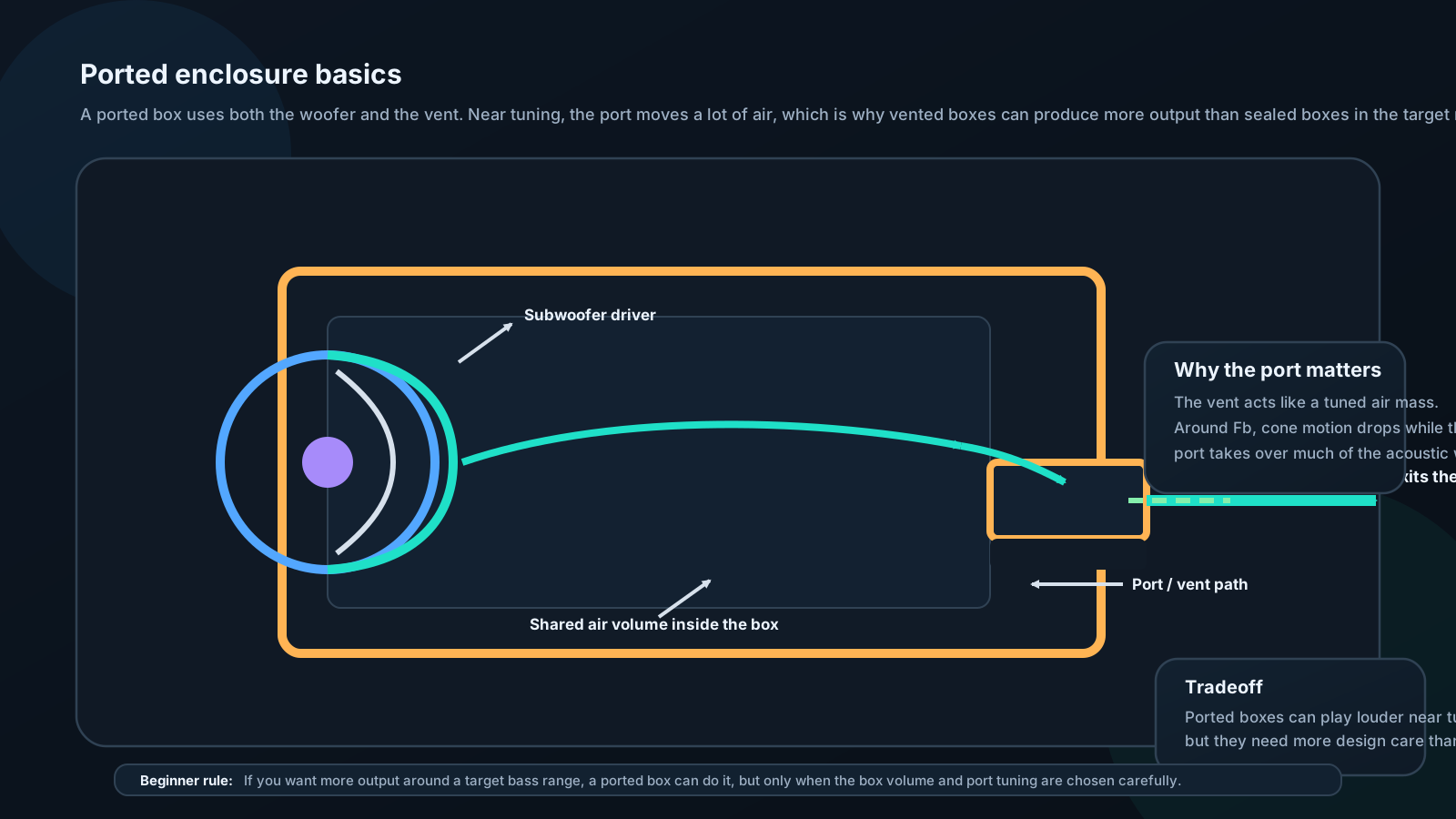
A ported subwoofer enclosure is a Helmholtz resonator — the same physics that makes a bottle "hoot" when you blow across the opening. The air mass in the port and the air volume inside the box form a spring-mass system that resonates at a specific frequency.

Beginner-friendly cross-section of a ported subwoofer enclosure showing the driver, vent, internal air path, and strong airflow out of the port near tuning
Use this as the base mental model for vented alignments: the cabinet volume and the port geometry work together so the vent contributes output strongly near Fb.

At the port's resonant frequency (Fb), something remarkable happens:

Below Fb, the port loses effectiveness, the cone takes over, excursion spikes, and the driver becomes vulnerable to damage. This is why ported enclosures require a subsonic filter — without one, a bass drop in a song can send the cone crashing into its limits below the tuning frequency.

Choosing Tuning Frequency

Fb = 0.8 × Fs (conservative): Extends bass below the driver's natural resonance. Lower output at Fb but better deep bass. More excursion near Fb.

Fb = Fs (neutral): Good balance of extension and output. Safe operation.

Fb = 1.1 × Fs (efficiency): Maximum output centered above driver resonance. Less deep bass. Common for SPL competition tuned to specific frequencies.

For music listening: Target Fb between 30–45 Hz for full bass reproduction. 35 Hz is a good all-around target for most popular music.

For competition: Tune to within 1–2 Hz of the test frequency. Everything else follows.

🔧 INSTALLER LEVEL: Port Design and Construction

Round vs Slot Ports

Round ports (tubes): - Simple to calculate - Easy to buy pre-made (PVC pipe, flared port tubes) - Can be cut to exact length - Susceptible to turbulence at high excursion if undersized

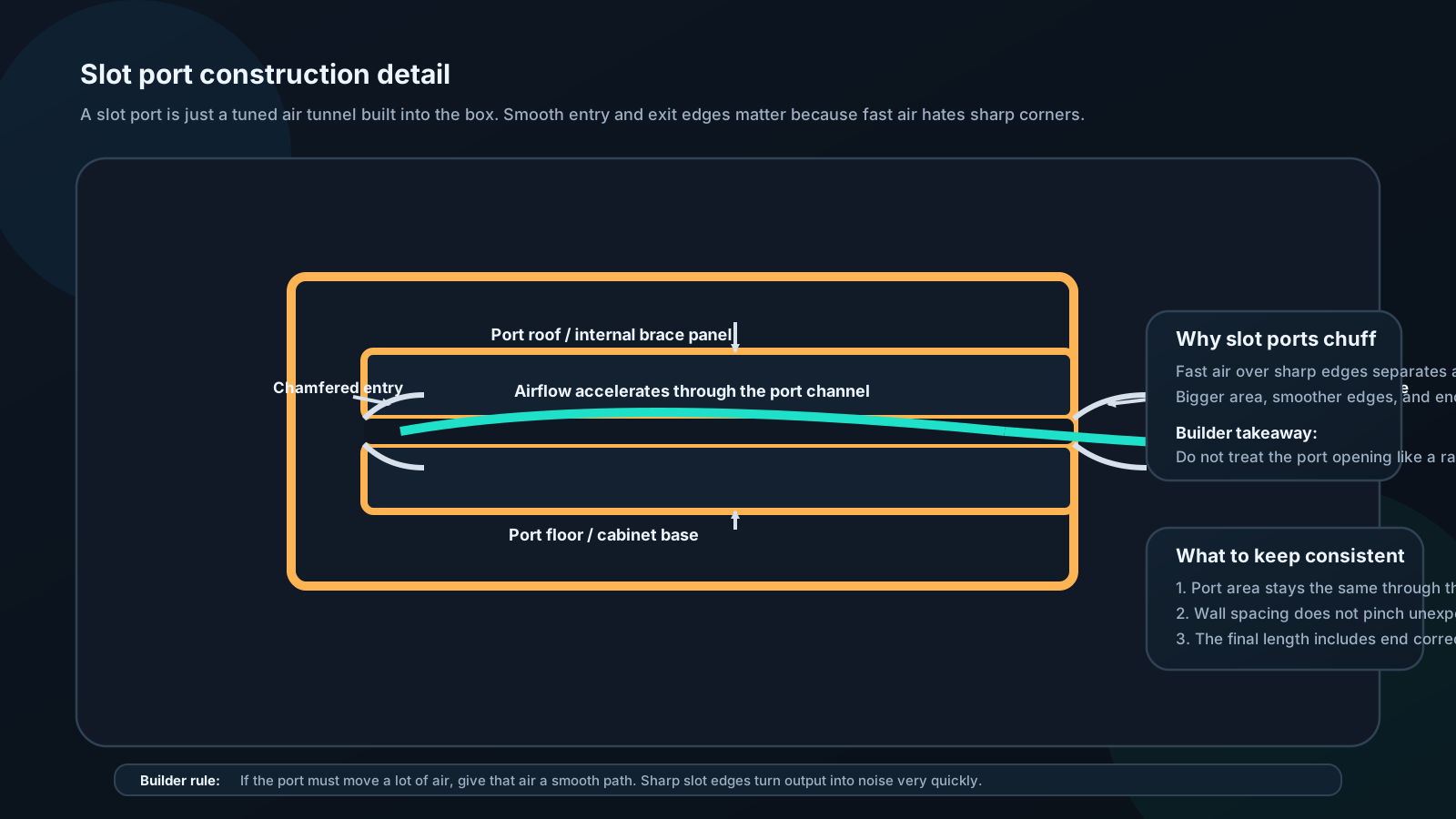
Slot ports (rectangular channels): - Built into the enclosure - Larger area = less turbulence for same tuning frequency - Looks cleaner - More complex to calculate (use hydraulic diameter: Dh = 4A/P where P = perimeter)

Port area guidelines:

Minimum port area to prevent audible turbulence (chuffing) at full excursion:

A_port_min (cm²) = Sd(cm²) × Xmax(cm) × Fb(Hz) / 30

This limits peak port velocity to approximately 30 m/s.

Cross-section of a slot port showing the port walls, chamfered entry, airflow path, and smooth exit needed to reduce turbulence and chuffing
Use this detail to keep the physical build honest: port area, edge treatment, and path smoothness all shape whether the finished vent behaves like a tuned resonator or a noisy leak.

Example: 12" driver, Sd = 490 cm², Xmax = 1.5 cm, Fb = 35 Hz:

A_min = 490 × 1.5 × 35 / 30 = 857 cm²

Wait — that's enormous. Let me recheck units. Xmax in meters:

A_min = 490cm² × 0.015m × 35Hz / 30 m/s
      = 490 × 0.015 × 35 / 30 cm² (keeping consistent)
      = 8.6 cm²

A single 3.3 cm (1.3") diameter round port provides 8.6 cm² — but that's tight. Use a 4" diameter port (12.6 cm²) or a slot port of 3 cm × 3 cm or larger.

Flared ports:

Port flares dramatically reduce turbulence at the port ends. Commercially made flared ports (Precision Port, Parts Express) allow 40–60% more airflow before chuffing compared to square-ended ports. Strongly recommended for any ported build above 500W.

Port Length Calculation

Helmholtz resonance formula solved for port length:

L_port = (2336 × A_port) / (Fb² × Vb) − 1.463 × √A_port

Where: - Lport = port length in inches - Aport = port cross-sectional area in square inches - Fb = tuning frequency in Hz - Vb = net box volume in cubic inches

Example: 2.0 ft³ = 3,456 in³ box, 4" round port (area = 12.57 in²), Fb = 35 Hz:

L_port = (2336 × 12.57) / (35² × 3456) − 1.463 × √12.57
       = 29,363 / 4,233,600 − 1.463 × 3.546
       = 0.00694 × ... 

Wait — let me use the correct constant form. The standard approximation:

L_port = (23562.5 × Ap) / (Fb² × Vb) − 1.463 × √Ap

Where all units are inches and cubic inches:

L = (23562.5 × 12.57) / (1225 × 3456) − 1.463 × 3.546
  = 296,190 / 4,233,600 − 5.19
  = 70.0 − 5.19
  = 64.8 inches

That is impossibly long for a 2.0 ft³ box. The issue: at 35 Hz tuning with a 4" port, the port must be very long. Either use a larger port area (more air mass = shorter length for same tuning) or increase box volume.

Practical solution: Use a 4" × 12" slot port (48 in² area):

L = (23562.5 × 48) / (1225 × 3456) − 1.463 × √48
  = 1,131,000 / 4,233,600 − 10.14
  = 267 − 10.14
  = 257 in?

Still very long. The reality: tuning a 2 ft³ box to 35 Hz requires a port that is impractically long unless the port area is very large. For a 2 ft³ box, realistic tuning is 45–55 Hz. For 35 Hz tuning, box volume needs to be 3–4 ft³ or larger.

This is the practical constraint nobody mentions: You cannot arbitrarily choose box size and tuning independently. They are coupled. For each driver and target tuning, there is a minimum practical box volume.

WinISD or BassBox Pro automates these calculations with real-time port length display as you adjust parameters. Highly recommended for any ported build.

⚙️ ENGINEER LEVEL: Fourth-Order Bandpass and Extended Alignments

Transfer Function — Ported System

The ported system is a fourth-order bandpass filter at low frequencies:

H(s) = s² / (s⁴ + as³ + bs² + cs + d)

Where a, b, c, d are functions of Fb, Fc, Qtc, and the coupling between box volume and port resonance.

The vented box equations (small signal):

Defining:

h = Fb/Fs    (tuning ratio)
α = Vas/Vb   (compliance ratio)

The four poles of the system form two complex pairs. Their positions in the s-plane determine the response shape.

Popular alignments for vented systems:

Butterworth B4 (4th order):

h = 1/(√2 × Qts)
α = 1/(2Qts²) − 1
Vb = Vas / α

Produces maximally flat 4th-order response. F3 below Fs.

Quasi-Butterworth QB3:

h ≈ Qts^0.44 × (Vas/Vb)^0.18

More practical approximation. Less computation, similar results.

Alignment selection software:

Manual calculation for ported alignments is tedious and error-prone. WinISD, BassBox Pro, and the free UniBox handle this correctly. Enter T/S parameters, select alignment, and software calculates all box parameters. Trust the software over hand calculations for ported work.