
Tiny version
A sealed box is like a woofer pushing on an air pillow.
A sealed box is like a woofer pushing on an air pillow.
Choose sealed when you want a simpler first build, strong woofer control, and a better chance of fitting the box in the vehicle without port drama.
The deeper math still matters, but the main practical choice is whether you want tight sound, small-space packaging, or a flatter larger alignment.
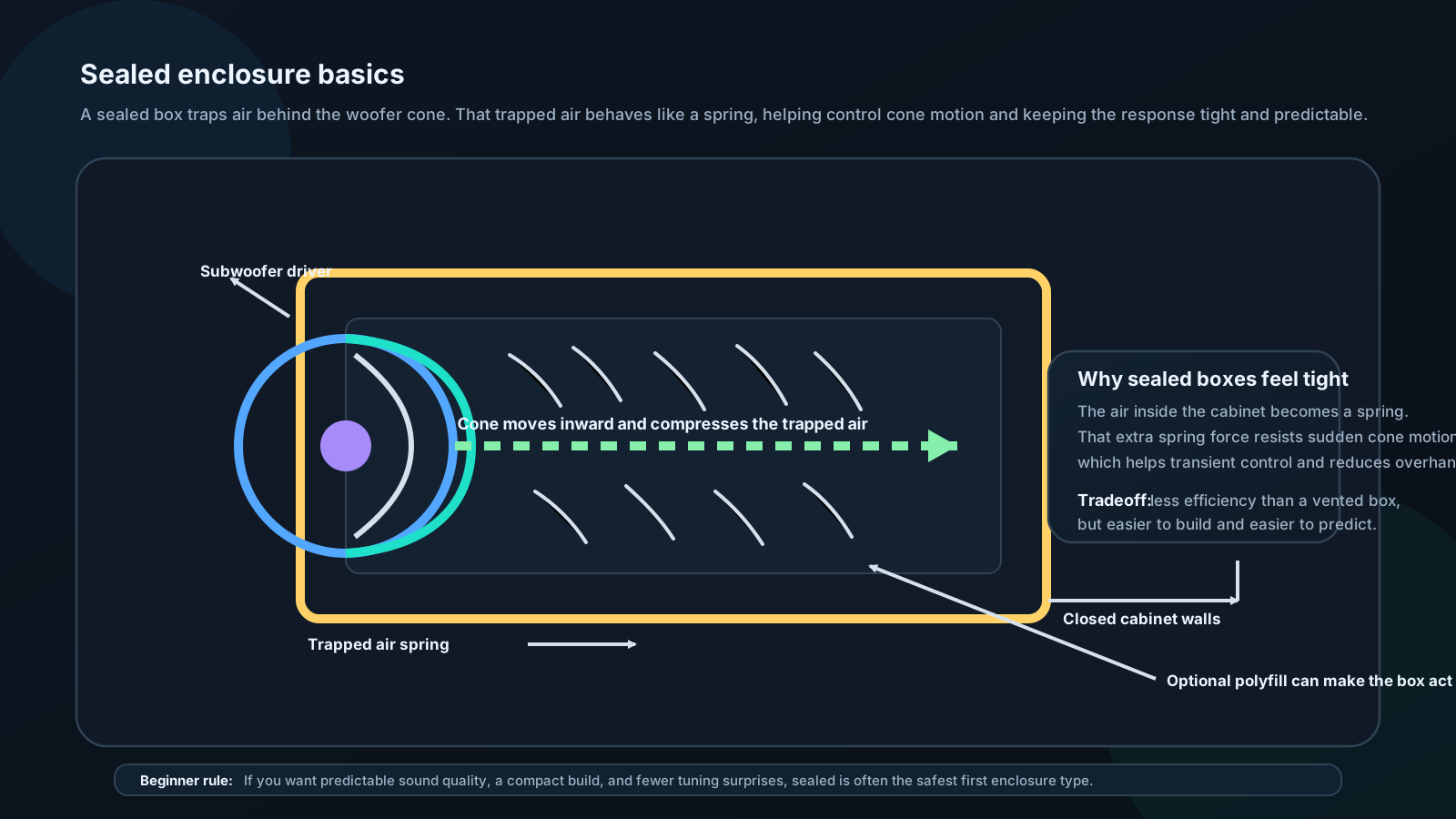
Choose sealed when you want tight sound, small-space packaging, and the simplest path to a clean first subwoofer build.
A sealed enclosure traps air behind the woofer cone. That trapped air behaves like an extra spring, so the driver sees more restoring force than it would in free air. The result is predictable bass, good mechanical control, and a gentle low-frequency rolloff that usually integrates well with cabin gain.
Polyfill can help when used correctly. A light, loose fill reduces internal reflections and can make the enclosure behave slightly larger than its physical volume. It is a trimming tool, not a magic fix for a badly undersized box.
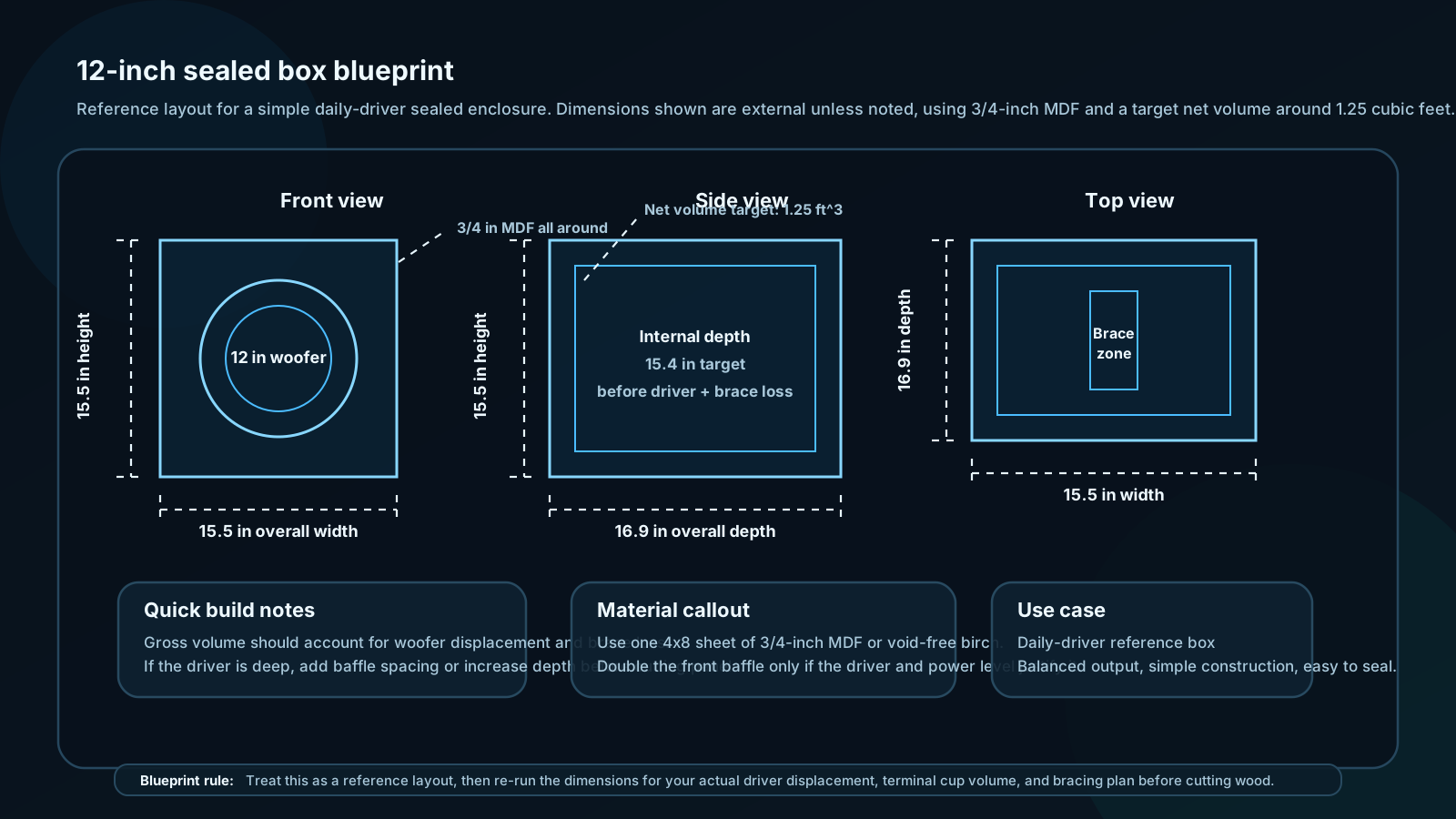
The most useful sealed-box decision is not "sealed or ported." It is which sealed alignment you are aiming for and how much box volume you can actually fit.
| Alignment | Typical Qtc | What It Sounds Like | Tradeoff |
|---|---|---|---|
| Bessel | 0.58 | Dry, tight, very controlled | Needs more box volume and gives up some extension |
| Butterworth | 0.71 | Balanced and flat | Often larger than the space available in real cars |
| Mild peak | 0.85 to 0.95 | A little extra warmth and punch | Not a textbook-flat response |
| Small-box peak | 1.0 and up | Very punchy or one-note if pushed too far | Higher resonance and more obvious response hump |
Fast chooser: Bessel means extra control, Butterworth means balanced and flat, and the higher-Qtc alignments trade accuracy for more punch when the box has to stay small.
The basic sizing formula is:
Vb = Vas / [ (Qtc / Qts)^2 - 1 ]That formula tells you how much net box volume is required to reach a chosen target Qtc. It is the right place to start, but you still have to account for driver displacement, brace volume, and the actual cargo-space limit in the vehicle.
This example uses a representative sealed-suitable 12-inch driver so you can follow the math from target Qtc to a realistic packaging compromise. Confirm current published specs before finalizing a cut sheet.
If we aim for a flat Butterworth alignment:
Vb = 3.54 / [ (0.707 / 0.51)^2 - 1 ]
Vb = 3.54 / (1.921 - 1)
Vb = 3.85 ft^3
That box will not fit the vehicle, so we check what happens when the packaging limit forces the design down to 1.5 ft^3:
Qtc = Qts x sqrt(Vas / Vb + 1)
Qtc = 0.51 x sqrt(3.54 / 1.5 + 1)
Qtc = 0.93
Qtc of 0.93 is a slightly peaked sealed alignment. It gives a little more output around system resonance than a Butterworth box, which is a reasonable trade when the packaging limit is 1.5 ft^3.
System resonance becomes:
Fc = Fs x (Qtc / Qts)
Fc = 28 x (0.93 / 0.51)
Fc = 51 Hz
The electrical -3 dB point for this alignment is roughly:
F3 = Fc x 0.815
F3 = 51 x 0.815
F3 = 41.5 Hz
This is not a flat Butterworth alignment. System resonance is around 51 Hz, and the electrical F3 is in the low-40 Hz range before cabin gain. In a typical vehicle that can still work well for music, but the box is a space-limited compromise rather than a textbook-flat alignment.
At low frequency, a sealed system behaves like a second-order high-pass filter. In practical system work that matters because Qtc shapes both the amplitude response and the time behavior around resonance.
H(s) = s^2 / (s^2 + (wc / Qtc)s + wc^2)The cleaner the target, the less overshoot you see around resonance. The smaller the box, the more that response tends to climb and the more obvious the time-domain penalty becomes. In most daily-driver systems the right answer is not the smallest possible enclosure; it is the smallest enclosure that still keeps the system honest for the owner and vehicle.