⚙️ ENGINEER LEVEL: Transmission Line and Passive Radiator Theory
Transmission Line Enclosures
A transmission line enclosure is a tapered acoustic tube, approximately quarter-wave length at the driver's resonance, stuffed with acoustic damping material. At the driver's resonance frequency, the tube presents a specific acoustic impedance that loads the driver, controlling resonance and extending bass response.
Quarter-wave length:
L = c / (4 × Fs)
At Fs = 35 Hz, c = 343 m/s:
L = 343 / (4 × 35) = 2.45 m (8 feet)
Practical transmission lines use 30–50% velocity of sound loading from stuffing material, reducing effective length:
L_physical ≈ L_acoustic × 0.7 = 1.7 m
Still extremely long — impractical for most car audio. Used occasionally in high-end home audio (PMC, Linn) but essentially absent from car installations.
Passive Radiator — Mechanical Analysis
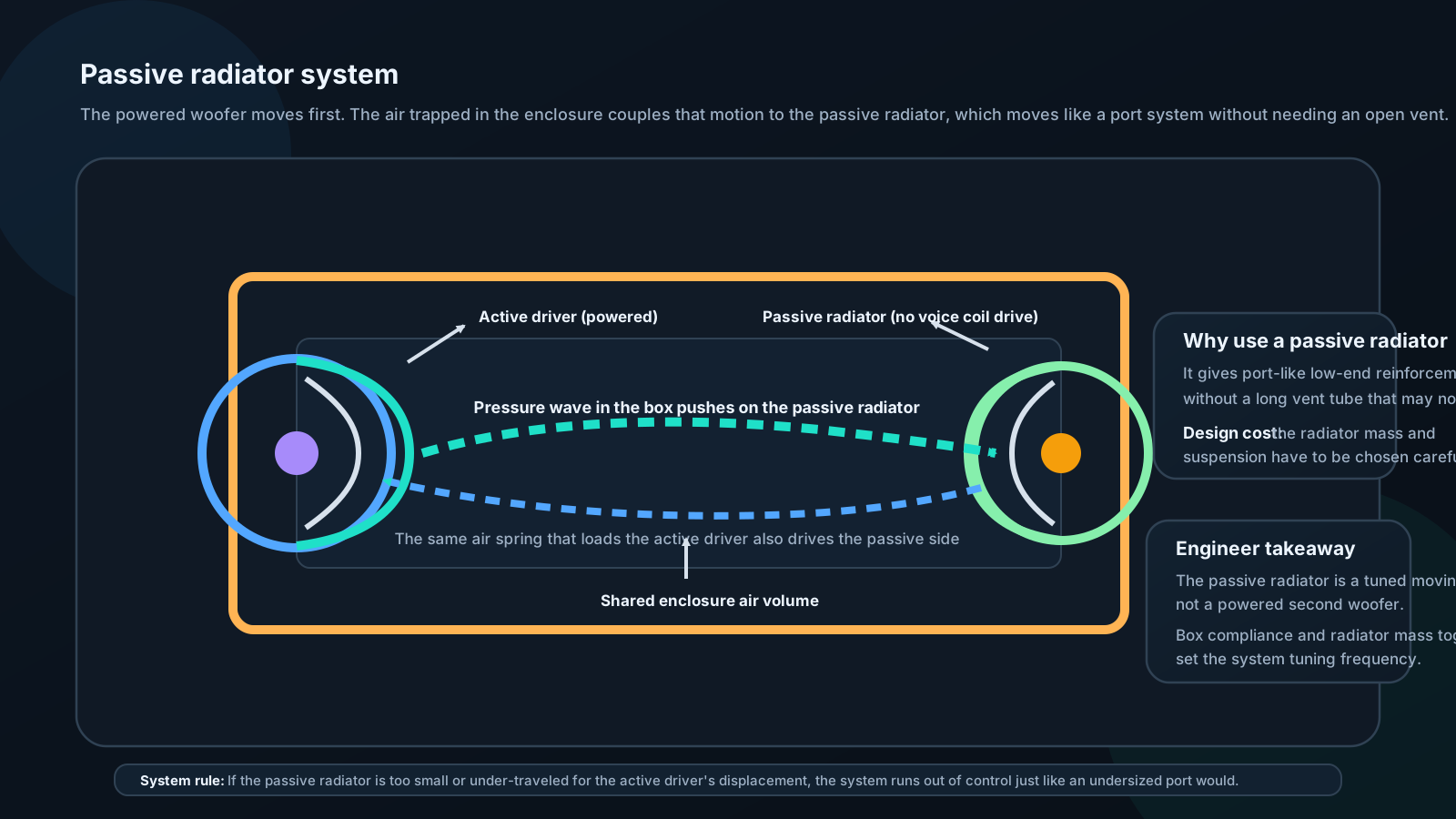
The passive radiator (PR) acts as a mechanically resonant mass-spring system:
PR free resonance:
Fpr = (1/2π) × √(Kpr / Mpr)
Where: - Kpr = suspension stiffness (N/m) = 1/Cpr - Mpr = total moving mass including added weights
Tuning the system:
The box + PR system resonance (equivalent to Fb in ported):
Fb_pr = (1/2π) × √[(Kpr + K_box) / Mpr]
Where K_box = ρ₀c²Sd²/Vb (air compliance stiffness of box)
For practical tuning, add mass to the PR cone (bolts, lead weights, putty) and measure system resonance via the impedance curve's double-peak location, just as you would verify port tuning in a ported box.
PR sizing requirements:
Sd_pr ≥ Sd_active     (same area or larger)
Xmax_pr ≥ Xmax_active × Sd_active/Sd_pr   (sufficient stroke)
The PR must handle the same volumetric displacement as the active driver — if it's the same size, same Xmax required. If it's larger, stroke requirement reduces proportionally.