⚙️ ENGINEER LEVEL: Modal Analysis and Loss Mechanisms
Finite Element Analysis for Enclosure Design
Panel vibration is a distributed-parameter problem — the response at every point on the panel depends on geometry, boundary conditions (how the edges are supported), material properties, and excitation.
Modal frequencies of a simply-supported rectangular panel:
f_mn = (π/2) × √(D/ρ_s) × √[(m/Lx)² + (n/Ly)²]
Where: - D = flexural rigidity = E×h³ / (12(1−ν²)) - ρ_s = surface mass density (kg/m²) - m, n = mode numbers (1,2,3...) - Lx, Ly = panel dimensions
For 3/4" MDF (E = 3 GPa, ρ = 750 kg/m³, ν = 0.3), 400mm × 500mm panel:
D = 3×10⁹ × (0.019)³ / (12 × (1−0.09)) = 1,897 N·m
ρ_s = 750 × 0.019 = 14.25 kg/m²

f_11 = (π/2) × √(1897/14.25) × √[(1/0.4)² + (1/0.5)²]
     = 1.571 × 11.53 × √(6.25 + 4.0)
     = 18.12 × 3.20
     = 58 Hz
The first panel mode at 58 Hz is squarely in subwoofer territory. This panel resonates at every bass note near 58 Hz — adding colored output that doesn't come from the driver.
Effect of bracing:
Adding a cross-brace at the panel center divides each dimension by approximately √2, raising f_11 by a factor of 2:
f_11_braced ≈ f_11 × 2 = 116 Hz
Still within problematic territory for some builds. Add a second brace for f_11 × 3 = 174 Hz — above most subwoofer crossover points.
Constrained Layer Damping — Loss Factor Calculation:
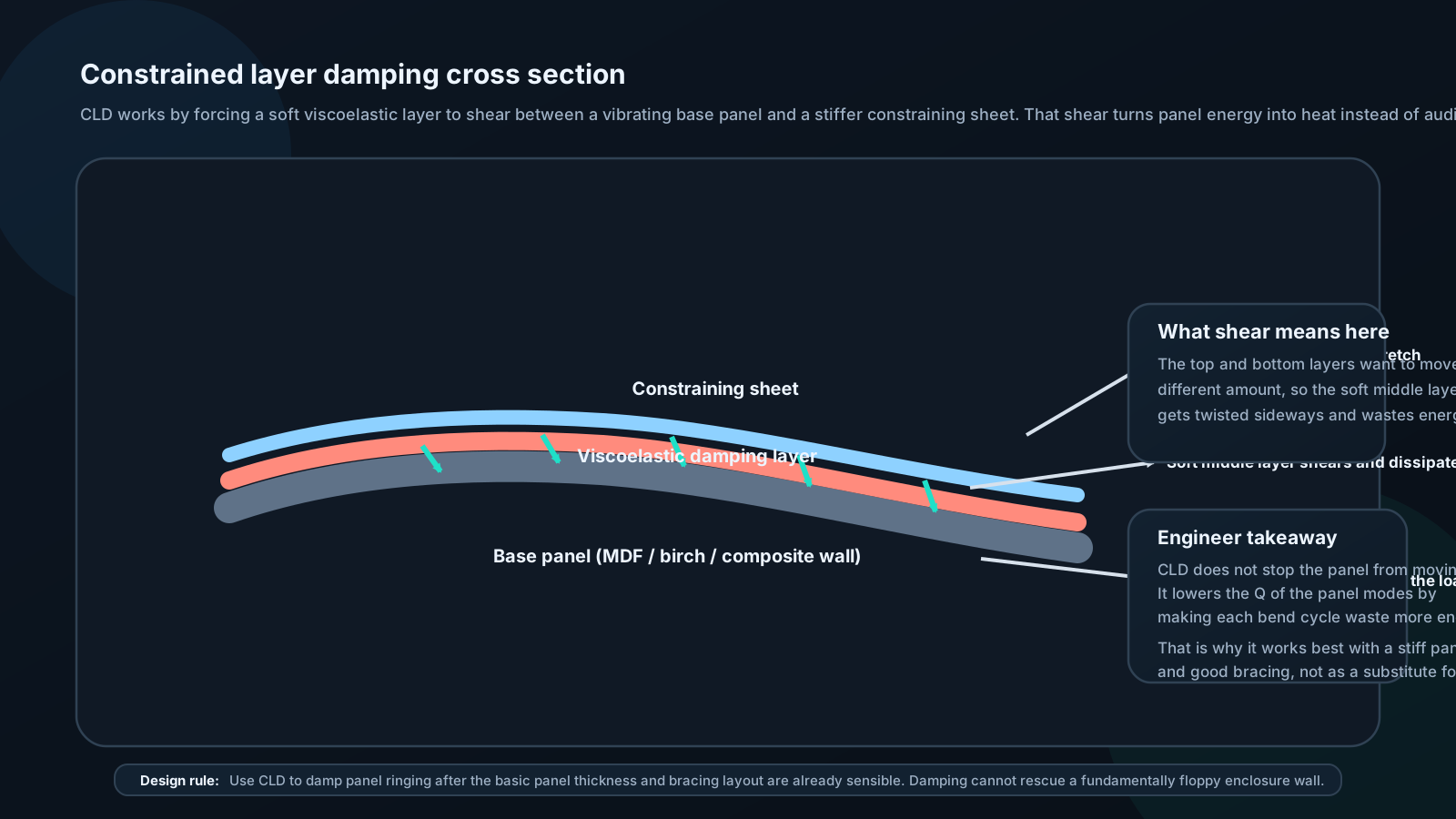
When a viscoelastic layer is sandwiched between the base panel and a constraining layer, bending of the base causes shear in the viscoelastic layer. Shear dissipates energy.
System loss factor:
η_total = η_v × H_c × g_c / (1 + g_c)
Where: - ηv = loss factor of viscoelastic layer (0.5–2.0 for butyl) - Hc = thickness parameter ratio - g_c = shear parameter
For practical CLD with butyl damping compound (2mm thick) on 19mm MDF:
Achievable η_total ≈ 0.1–0.3
Effect on Q of panel resonance:
Q_panel = 1 / η_total
Undamped: Q = 50–100 (sharp, ringing resonance) With CLD: Q = 3–10 (well-damped, minimal coloration)
Reduction in resonance peak:
Reduction_dB = 20 × log₁₀(Q_undamped / Q_damped)
             = 20 × log₁₀(50/5) = 20 dB