Ohmic Audio

9.3 Speaker and Enclosure Reference Diagrams

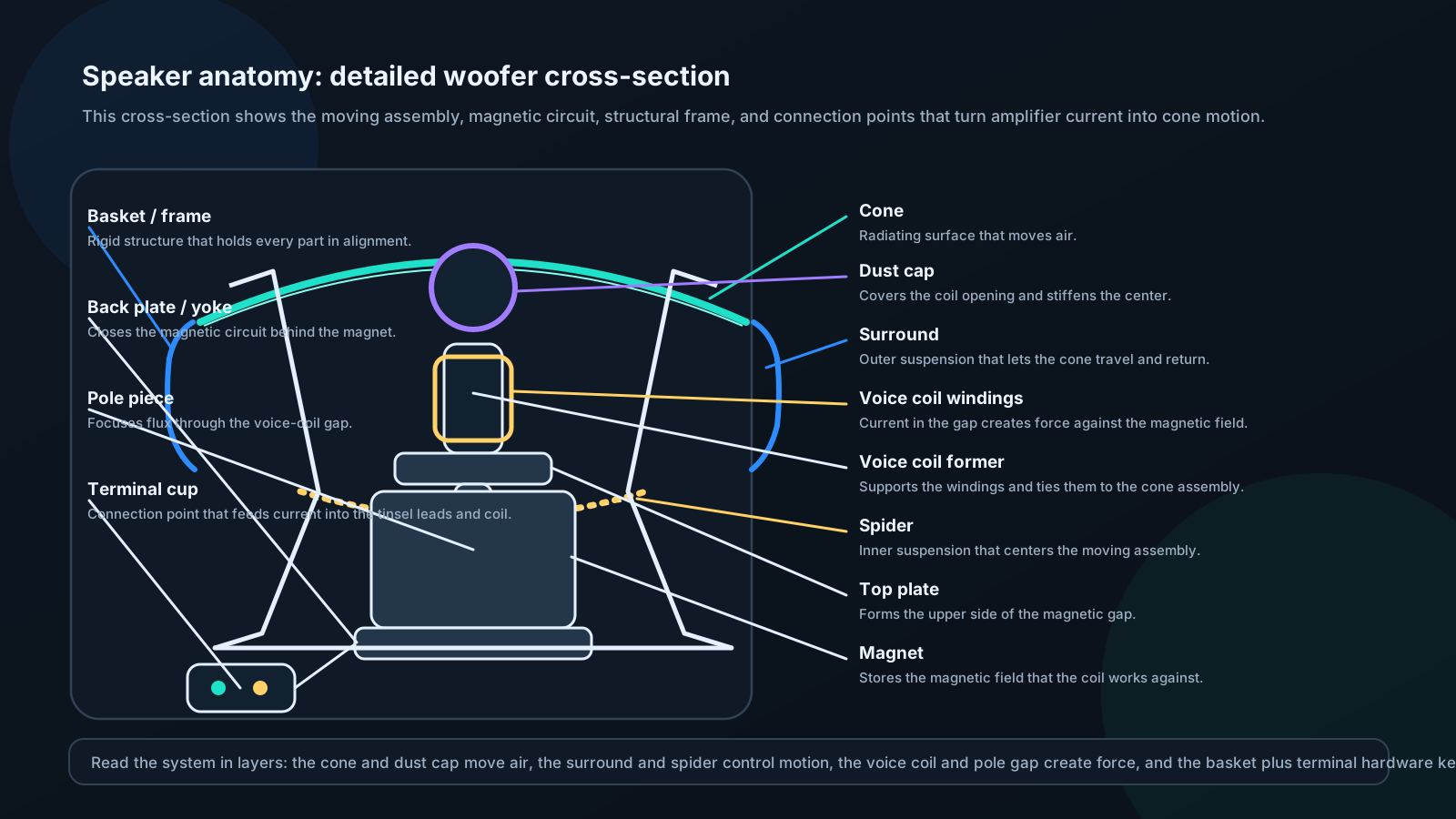
Speaker Anatomy Cross-Section

Detailed woofer cross-section labeling dust cap, cone, surround, spider, voice coil former, voice coil windings, top plate, magnet, back plate, pole piece, basket frame, and terminal cup
A detailed speaker diagram is useful because it separates the moving parts, suspension, magnetic circuit, and frame. That makes it easier to connect build quality, cooling, excursion limits, and failure modes back to the hardware you can actually inspect.

Key components and their roles:

Component Material Function
Cone Paper, polypropylene, aluminum, Kevlar Moves air to create sound
Surround Foam, rubber, cloth Allows cone travel, returns to center
Spider Treated fabric Primary centering, spring force
Voice coil Aluminum or copper wire Converts electrical to mechanical
Magnet Ferrite or neodymium Creates static magnetic field
Pole piece Steel Focuses magnetic field through gap
Basket Stamped or cast aluminum Structural support

Thiele-Small Parameter Reference

Illustration in preparation Description: Impedance curve with TS parameters annotated: Fs at impedance peak, Re at lowest impedance, f1 and f2 at √(Re×Zmax) points for Q calculation, Zmax at peak

Complete parameter set:

Parameter Symbol Units Typical Range (subwoofer)
Free-air resonance Fs Hz 20–50 Hz
DC voice coil resistance Re Ω 2–8 Ω
Voice coil inductance Le mH 0.5–8 mH
Electrical Q Qes — 0.3–1.5
Mechanical Q Qms — 2–10
Total Q Qts — 0.2–1.2
Compliance volume Vas L or ft³ 20–200 L
Linear excursion Xmax mm 5–30 mm
Effective piston area Sd cm² 200–800 cm²
Sensitivity SPL dB/W/m 83–97 dB
Power handling Pe W 100–3000 W

Illustration in preparation Description: Flowchart from T/S parameters to enclosure recommendation: check Qts first → if <0.4 ported/bandpass; 0.4–0.7 either; >0.7 sealed; then Vas determines box volume, Fs determines tuning


Sealed Enclosure Blueprints

Illustration in preparation Description: Dimensioned blueprint (front, side, top views) for a 1.25 ft³ sealed enclosure for a 12" subwoofer; all dimensions in inches; panel thicknesses marked (3/4" MDF); corner bracing shown; terminal cup location; dimensions: 14"W × 14"H × 16"D exterior

Illustration in preparation Description: Cut diagram showing how to cut all panels from a 4×8 sheet of MDF with minimal waste; panels labeled with dimensions

Material requirements for 1.25 ft³ box:

Panel Quantity Dimensions
Top/Bottom 2 14" × 16"
Left/Right 2 14" × 14.5"
Front 1 14" × 14.5"
Back 1 14" × 14.5"
Bracing 4 2" × 12" strips

Material: 3/4" MDF. One full 4×8 sheet required.


Ported Enclosure Blueprints

Illustration in preparation Description: Dimensioned blueprint for a 2.0 ft³ ported enclosure: exterior dimensions 18"W × 14"H × 18"D; slot port specifications (3" × 14" × 9" long); driver mounting template; terminal location

Illustration in preparation Description: Detailed cross-section of slot port construction showing port walls, end termination, chamfering, and airflow path through port

Slot port construction:

A slot port is essentially a wooden tube with rectangular cross-section, built inside the enclosure:

  1. Port side walls: Two vertical pieces running full enclosure depth
  2. Port divider: Horizontal piece separating port channel from driver chamber
  3. Port opening: At front or side of enclosure
  4. Chamfer port entry: 45° bevel reduces turbulence at port entrance

Calculating slot port dimensions:

Port area = width × height Port length = calculated from Helmholtz formula (Chapter 6.3)

Example: 3" × 14" slot = 42 in² area; calculate length for target Fb.


Bandpass Enclosure Blueprint

Illustration in preparation Description: Cross-section diagram and dimensioned blueprint for 4th-order bandpass: sealed rear chamber (left), driver mounted in center baffle, ported front chamber (right); dimensions for each chamber separately; port specifications

Chamber volume ratio:

For flat response at competition frequencies: - Sealed chamber: 0.6–0.8 × Vas - Ported chamber: 1.5–2.5 × Vas - Port tuned to desired frequency

Construction notes:

The center baffle (where driver mounts) must be the most rigid panel. Use 1.5" MDF or doubled 3/4" MDF for center. Seal the driver gasket with butyl rope or RTV silicone — no air leaks between chambers.