
6.2 Acoustic Formulas
Speed of Sound
c = 331.4 × √(1 + T_celsius / 273.15) [m/s]
Or approximately:
c ≈ 331.4 + 0.606 × T_celsius [m/s]
| Temperature | Speed of Sound |
|---|---|
| 0°C (32°F) | 331 m/s |
| 10°C (50°F) | 337 m/s |
| 20°C (68°F) | 343 m/s |
| 30°C (86°F) | 349 m/s |
| 40°C (104°F) | 355 m/s |
Inches per millisecond (useful for time alignment):
c = 13,500 in/s = 13.5 in/ms
Delay per inch of distance difference:
t = 1 / 13.5 = 0.074 ms per inch
Wavelength
λ = c / f
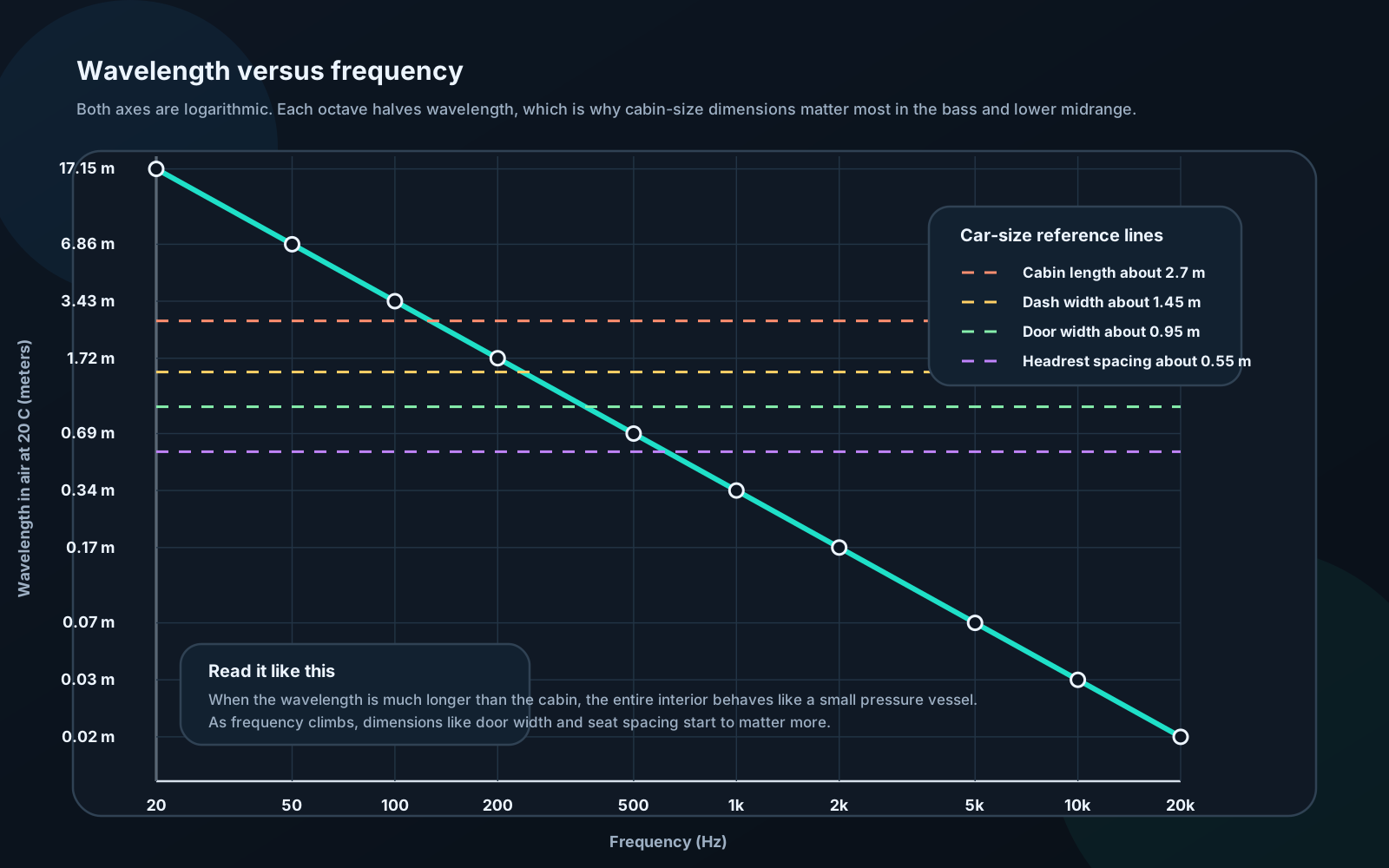
| Frequency | Wavelength (at 20°C) |
|---|---|
| 20 Hz | 17.2 m (56 ft) |
| 40 Hz | 8.6 m (28 ft) |
| 80 Hz | 4.3 m (14 ft) |
| 160 Hz | 2.1 m (7 ft) |
| 500 Hz | 0.69 m (27 in) |
| 1,000 Hz | 0.34 m (13.5 in) |
| 2,000 Hz | 0.17 m (6.7 in) |
| 4,000 Hz | 0.086 m (3.4 in) |
| 10,000 Hz | 0.034 m (1.3 in) |
| 20,000 Hz | 0.017 m (0.67 in) |
Practical implications:
- Sound waves above ~1 kHz have wavelengths shorter than typical speaker separation distances — these frequencies are directional and imaging-sensitive
- Crossover frequencies above 1 kHz require careful time alignment
- Bass frequencies (below 200 Hz) have wavelengths longer than the cabin — they pressurize the whole space
SPL Addition
Adding independent sources (different signals):
SPL_total = 10 × log₁₀(10^(SPL₁/10) + 10^(SPL₂/10) + ...)
Simplified — equal level sources:
SPL_total = SPL_single + 10 × log₁₀(N)
Where N = number of identical sources
| Sources | SPL addition |
|---|---|
| 2 | +3 dB |
| 4 | +6 dB |
| 8 | +9 dB |
| 10 | +10 dB |
| 100 | +20 dB |
Adding coherent sources (same signal, same phase):
SPL_total = SPL_single + 20 × log₁₀(N)
| Sources | SPL addition (coherent) |
|---|---|
| 2 | +6 dB |
| 4 | +12 dB |
Worked example — two subwoofers:
Two identical 12" subwoofers, each producing 100 dB at 1W/1m:
Incoherent (different signals — stereo): 100 + 3 = 103 dB Coherent (same mono signal, summed): 100 + 6 = 106 dB
This is why SPL competition uses mono signal and carefully phased multiple drivers — coherent addition gives maximum output.
SPL vs Power vs Distance
SPL from power:
SPL = Sensitivity + 10 × log₁₀(P)
Where Sensitivity is in dB/W/m (at 1 watt, 1 meter)
SPL vs distance (free field):
SPL_distance = SPL_reference − 20 × log₁₀(d / d_reference)
Equivalently: Every doubling of distance = −6 dB
Combined formula:
SPL = Sensitivity + 10 × log₁₀(P) − 20 × log₁₀(d)
Worked example:
Speaker sensitivity: 90 dB/W/m Power: 100W Distance: 1m
SPL = 90 + 10 × log₁₀(100) − 20 × log₁₀(1)
SPL = 90 + 20 − 0 = 110 dB
At 0.5m (half distance, in-car listening):
SPL = 90 + 20 − 20 × log₁₀(0.5) = 110 + 6 = 116 dB
Acoustic Power Efficiency
Loudspeaker efficiency (η):
η = P_acoustic / P_electrical
Sensitivity and efficiency relationship:
η ≈ 10^((Sensitivity − 112) / 10)
| Sensitivity (dB/W/m) | Efficiency |
|---|---|
| 85 | 0.03% |
| 88 | 0.06% |
| 91 | 0.12% |
| 94 | 0.25% |
| 97 | 0.50% |
| 100 | 1.0% |
From Thiele-Small parameters:
η₀ = (4π² / c³) × (f_s³ × Vas / Qes)
Simplified:
η₀ ≈ (9.64 × 10⁻⁷) × (f_s³ × Vas / Qes)
Where Vas in liters, f_s in Hz.
Worked example:
Subwoofer: f_s = 35 Hz, Vas = 50L, Qes = 0.5
η₀ = (9.64 × 10⁻⁷) × (35³ × 50 / 0.5)
η₀ = (9.64 × 10⁻⁷) × (42,875 × 100)
η₀ = (9.64 × 10⁻⁷) × 4,287,500
η₀ = 0.00413 = 0.41%
Sensitivity at 1W/1m:
Sensitivity = 112 + 10 × log₁₀(0.0041) = 112 − 23.8 = 88.2 dB/W/m
Room Modes and Cabin Resonance
Axial room modes (one dimension):
f_n = n × c / (2L)
Where n = 1, 2, 3... (mode number), L = room dimension
For car cabin (approximate length 4m):
f₁ = 343 / (2 × 4) = 42.9 Hz  (1st axial mode)
f₂ = 85.8 Hz
f₃ = 128.6 Hz
Three-dimensional modes:
f_lmn = (c/2) × √((l/L_x)² + (m/L_y)² + (n/L_z)²)
Where l, m, n are integers and Lx, Ly, L_z are room dimensions.
Cabin gain formula (simplified):
ΔSPl_cabin ≈ 20 × log₁₀(c / (2πf × V^(1/3)))
This approximates the pressure buildup in a small, sealed enclosure below the first resonant frequency.