
6.1 Electrical Formulas
Ohm's Law and Power
The foundation of all electrical work in car audio.
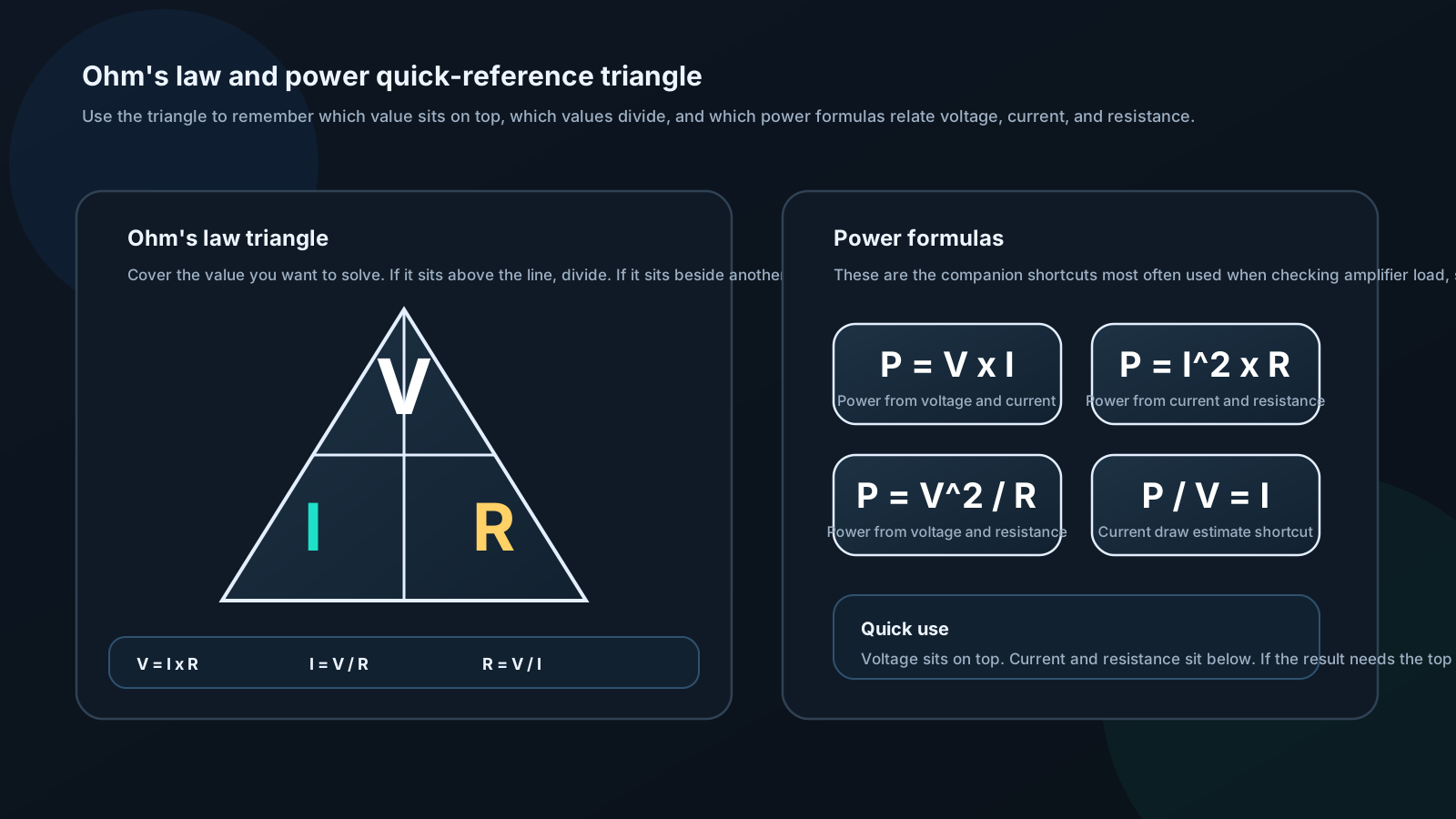
Ohm's Law:
V = I × R
I = V / R
R = V / I
Power:
P = V × I
P = I² × R
P = V² / R
Worked example — amplifier current draw:
A 500W RMS Class D amplifier (85% efficient) running from a 12V system:
P_input = P_output / η = 500 / 0.85 = 588W
I = P / V = 588 / 12 = 49A continuous
Add 25% safety margin for fuse and wire sizing:
I_design = 49 × 1.25 = 61A
Minimum wire gauge: 6 AWG (101A rated). Minimum fuse: 80A ANL.
Voltage Drop in DC Circuits
Formula:
V_drop = I × R_wire
R_wire = ρ × (2L) / A
Where: - ρ = copper resistivity = 1.68 × 10⁻⁸ Ω·m - L = one-way wire length (m) - A = cross-sectional area (m²) - 2L accounts for both positive and negative conductors
Simplified (using AWG table values):
V_drop = I × (Ω_per_foot × 2L_feet)
Target: V_drop < 3% of supply voltage (< 0.36V on 12V system)
Worked example:
100A amplifier, 15-foot run, 4 AWG wire (0.025 Ω per 100 ft):
R = 0.025 × (2 × 15) / 100 = 0.0075 Ω
V_drop = 100 × 0.0075 = 0.75V (6.25%) — too high
Try 2 AWG (0.016 Ω per 100 ft):
R = 0.016 × 30 / 100 = 0.0048 Ω
V_drop = 100 × 0.0048 = 0.48V (4%) — marginal
Try 0 AWG (0.010 Ω per 100 ft):
R = 0.010 × 30 / 100 = 0.003 Ω
V_drop = 100 × 0.003 = 0.30V (2.5%) — acceptable ✓
Speaker Impedance — Series and Parallel
Series:
Z_total = Z₁ + Z₂ + Z₃ + ...
Parallel (two speakers):
Z_total = (Z₁ × Z₂) / (Z₁ + Z₂)
Parallel (equal impedances, N speakers):
Z_total = Z / N
Mixed series-parallel:
Solve in stages. Combine series groups first, then combine those results in parallel.
Worked example — two DVC 4Ω subwoofers, target 2Ω:
Each subwoofer has two 4Ω coils. Wire each sub's coils in parallel first:
Z_coils_parallel = 4 / 2 = 2Ω per sub
Then wire both subs in parallel:
Z_total = 2 / 2 = 1Ω
Too low. Try coils in series per sub:
Z_coils_series = 4 + 4 = 8Ω per sub
Both subs in parallel:
Z_total = 8 / 2 = 4Ω
For 2Ω: Wire each sub's coils in parallel (2Ω each), then wire the two subs in series:
Z_total = 2 + 2 = 4Ω — same
For actual 2Ω from two DVC 4Ω subs: Each coil in series = 8Ω. Both subs parallel:
Z_total = 8 × 8 / (8 + 8) = 4Ω — still 4
Final approach — all four coils wired: two series pairs, paralleled:
Series pair A: 4 + 4 = 8Ω
Series pair B: 4 + 4 = 8Ω
Parallel: 8 × 8 / 16 = 4Ω — still 4
To get 2Ω from two DVC 4Ω subs, wire coils in parallel first (2Ω each), then parallel both subs: 1Ω — or use the coils in series (8Ω each), parallel = 4Ω.
There is no configuration that gives 2Ω from two DVC 4Ω subs. This is a common point of confusion — the available impedances are 1Ω and 4Ω only.
Damping Factor
Definition:
DF = Z_speaker / Z_output_amplifier
Output impedance from spec:
Z_output = Z_speaker / DF_rated
System damping factor (including wire resistance):
DF_system = Z_speaker / (Z_output + R_wire)
Worked example:
Amplifier: DF = 500, speaker = 4Ω
Z_output = 4 / 500 = 0.008Ω
16 AWG speaker wire, 12-foot run (24 feet round trip):
R_wire = (4.016 Ω/1000ft) × 24 = 0.096Ω
DF_system = 4 / (0.008 + 0.096) = 4 / 0.104 = 38
Amplifier rated DF of 500 reduced to 38 by speaker wire alone. This is why speaker wire gauge matters even for passive systems. Upgrading to 12 AWG:
R_wire = (1.588/1000) × 24 = 0.038Ω
DF_system = 4 / (0.008 + 0.038) = 87
Still far below amplifier's rated DF — wire dominates.
Ground Resistance and Noise
Ground loop noise voltage:
V_noise = I_ground × R_ground_path
Required ground resistance for quiet system:
R_ground < V_noise_acceptable / I_ground
Worked example:
Amplifier draws 50A average. Acceptable noise floor: 1mV (-60 dBV).
R_required = 0.001 / 50 = 0.00002Ω = 20 μΩ
This is extremely low — essentially impossible with real wire. The reason ground noise is manageable in practice is that the audio signal is much larger than the noise floor requirement at typical listening levels. The critical ratio is signal-to-noise, not absolute noise.
Practical target: Ground resistance < 0.1Ω, measured from amplifier chassis to battery negative.