5.1 Head Units: OEM Replacement and Retention Strategies
🔰 BEGINNER LEVEL: Choosing the Right Head Unit
What a Head Unit Does
The head unit — also called the source unit, deck, or receiver — is the brain of the car audio system. It handles:
- Source selection: Radio, streaming, USB, Bluetooth, auxiliary
- Signal processing: Basic EQ, crossovers, level control
- User interface: Display, buttons, touchscreen, voice control
- System control: Remote turn-on output for amplifiers, power antenna
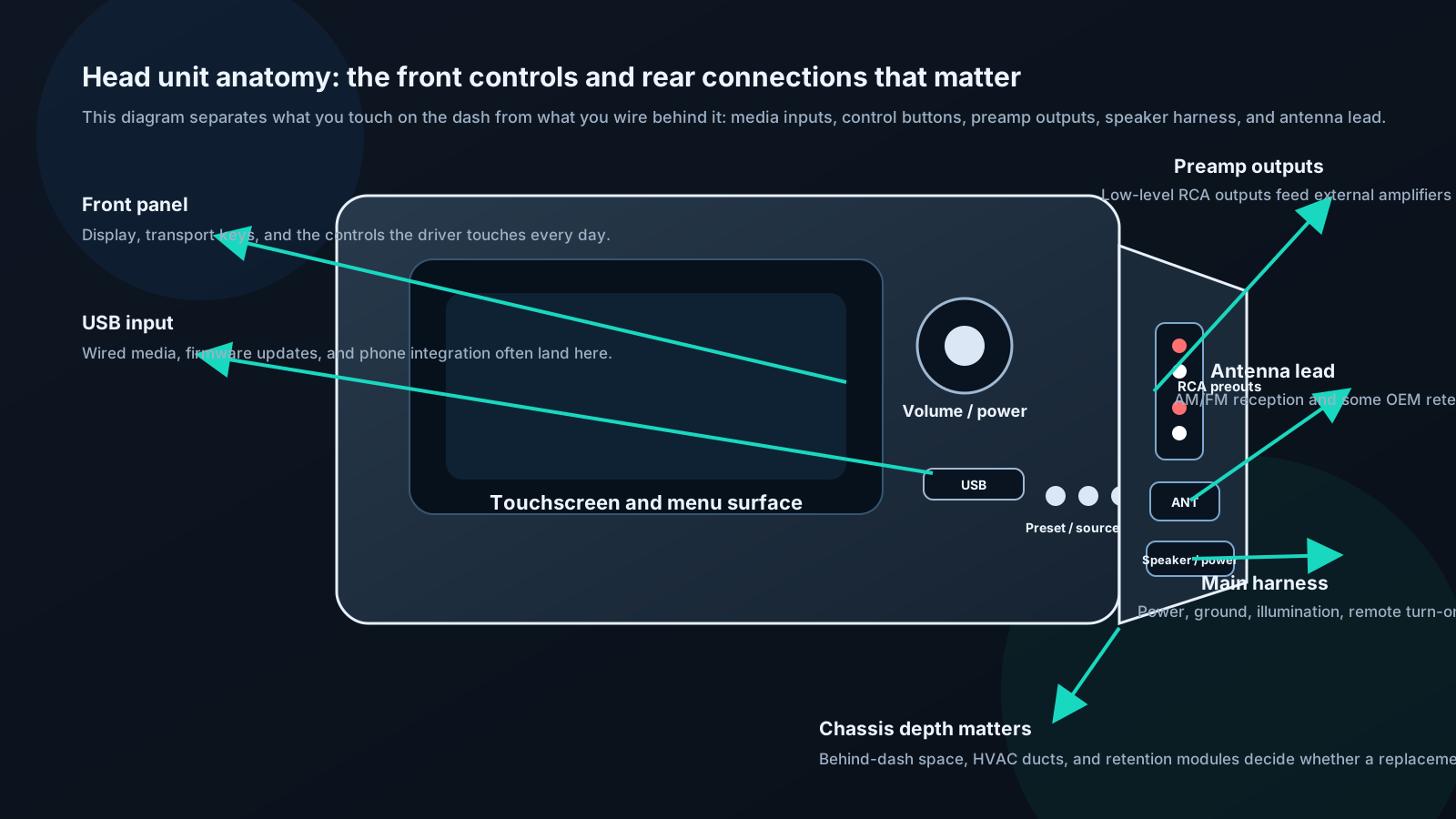
Every head unit has two fundamental outputs:
Speaker outputs (built-in amplifier): 4 channels, typically 18–22W RMS each (despite "50W max" marketing claims). Good enough for factory speakers without additional amplification.
Preamp outputs (RCA jacks): Low-level signal for external amplifiers. Voltage determines signal quality: 2V is adequate, 4V is good, 5–6V is excellent.
If you're adding external amplifiers — which almost everyone does for a quality system — the preamp output voltage matters significantly. It determines how much noise floor you can afford to add from cabling and amplifier input stages.
Single-DIN vs Double-DIN
Single-DIN: 2 inches tall × 7 inches wide. Older standard, still common in trucks and economy vehicles. Limited touchscreen size. Typically less featured.
Double-DIN: 4 inches tall × 7 inches wide. Standard for most modern aftermarket units. Large touchscreen possible. Full Android Auto / Apple CarPlay support.
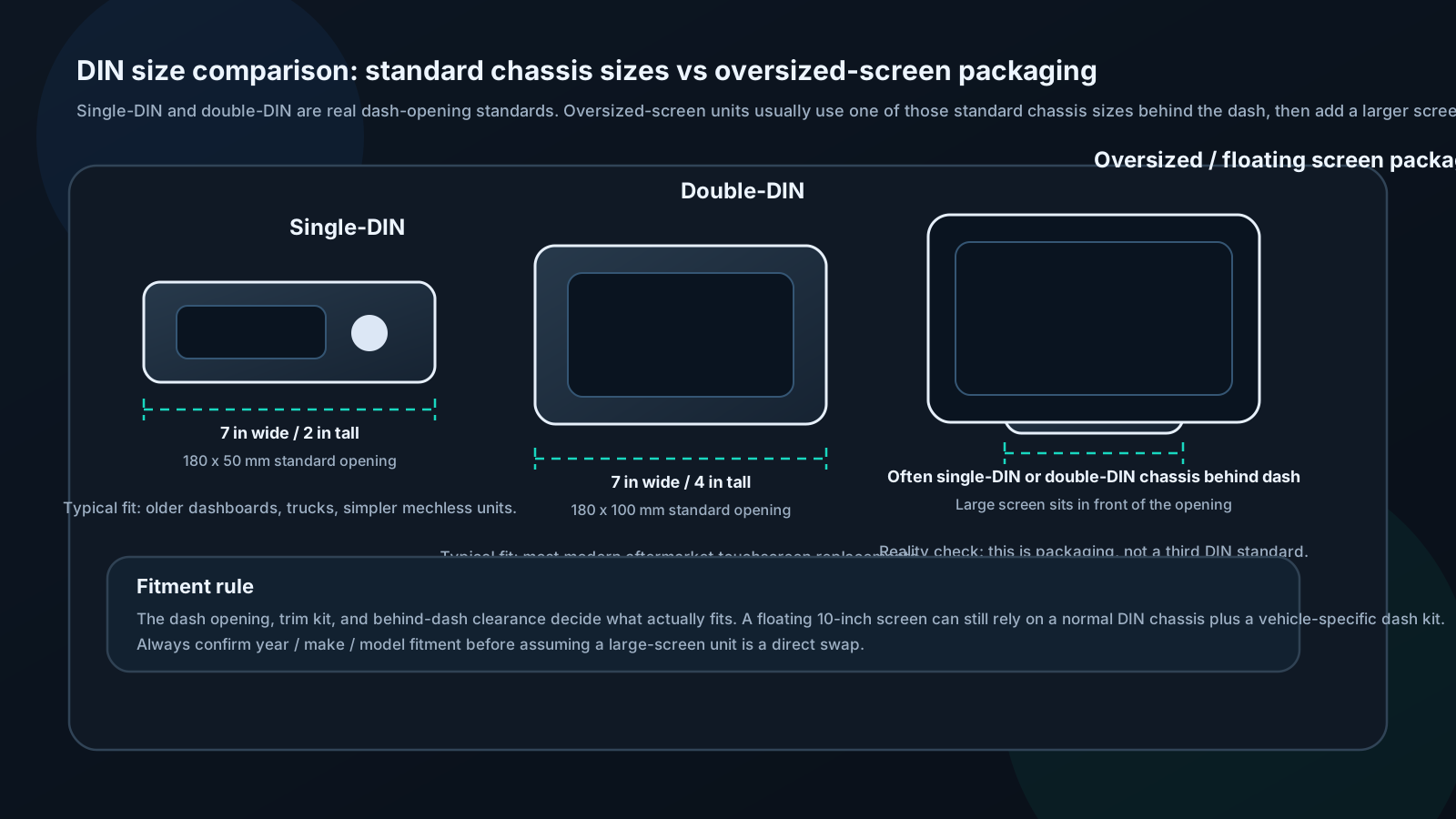
Checking your vehicle: Use Crutchfield, Metra, or Scosche compatibility tools. Enter year/make/model and they'll tell you the DIN size, required adapter kit, and what wiring harness you need. Never guess on this — dash shapes vary wildly.
Key Features to Evaluate
Preamp output voltage: - 2V: Minimum acceptable - 4V: Good for most systems - 5–6V: Excellent, use with high-performance builds
Preamp output channels: - 2-channel (front): Basic, forces sharing a single pair of RCAs - 4-channel (front + rear): Standard - 6-channel (front + rear + subwoofer): Better, dedicated sub output - 8-channel: Premium, useful for active 3-way systems
Built-in DSP: - Time alignment capability - Parametric EQ bands (4–13 typical) - High-pass filtering per channel - Some units include room correction (Audyssey, DTA)
Source inputs: - AM/FM tuner (still useful for emergency/local) - USB-A, USB-C - Bluetooth (5.0 or later preferred) - Auxiliary 3.5mm - Apple CarPlay / Android Auto (wired and wireless) - SiriusXM readiness (requires separate tuner) - HD Radio
Display: - 6.2", 7", 9", 10.1" diagonal most common - Capacitive touchscreen vs resistive (capacitive is better — responds to fingertip) - Brightness: 500–1000 nits acceptable, higher better for direct sunlight
Selecting by Use Case
Budget daily driver ($100–200):
Pioneer MVH-S622BS, Kenwood KMM-BT738HD - Bluetooth, USB, basic EQ - Adequate preamp output (2–4V) - No Apple CarPlay - Gets the job done
Mid-range with CarPlay ($250–400):
Pioneer AVH-W4500NEX, Kenwood DDX9907XR - Wireless CarPlay and Android Auto - 4–5V preamp output - Better time alignment and EQ - Good display quality
High-performance ($400–800):
Pioneer DMH-WT8600NEX, Kenwood Excelon DDX9907XR - 6V preamp output - Full DSP suite - Multiple preamp output pairs - Premium display
Reference-grade ($800–1500+):
Alpine Halo iLX-F511, Clarion NX706 - 7V+ preamp output - Advanced tuning software - OEM integration options - Used as signal processor in high-end builds
🔧 INSTALLER LEVEL: Installation and Integration
Wiring Harness and Adapter Selection

Every vehicle uses a proprietary connector on the factory wiring. You do not cut factory wires. You use a harness adapter that plugs into the factory connector and breaks the vehicle side out into standard aftermarket wire colors.
Harness adapter brands:
- Metra: Most comprehensive coverage, industry standard
- PAC: Excellent quality, signal processing versions available
- Scosche: Good value, solid selection
- Axxess: OEM integration specialists
Example — 2019 Toyota Camry:
Factory connector: Toyota 6+6 pin Required harness: Metra 70-8114 Provides: Standard aftermarket ISO colors + connector for head unit
The harness adapter handles: - Constant 12V (yellow wire) - Switched 12V / accessory (red wire) - Illumination wire (orange) - Ground (black) - All four speaker pairs (gray/white/green/purple with stripes) - Remote turn-on output (blue/white) - Power antenna output (blue)
Dash kit:
Also called a trim kit or installation kit. A plastic bezel that fills the gap between the new head unit and the factory dash opening. Often includes a mounting bracket.
Example: Metra 95-8214 for Toyota Camry — snap-in, no drilling, factory appearance.
Never assume generic fit. A dash kit that fits a 2018 Camry may not fit a 2019. Cross-reference by VIN when in doubt.
Common Installation Errors
1. Not connecting the ground wire properly
Symptom: Head unit powers on, then shuts off. Display flickers. Audio drops out. Fix: Head unit ground must go to a solid chassis ground — not rely on the harness alone. Run a separate 18 AWG wire from the head unit chassis or ground wire directly to clean metal.
2. Ignoring the parking brake wire
Modern head units require the parking brake wire to be connected to activate video and certain features. This is a safety interlock.
For navigation use while stationary: Connect parking brake wire to ground. For passenger-seat operation while driving: This bypasses a safety feature. Some choose to do this — understand you're removing an intentional restriction.
3. Reversed speaker polarity
Symptom: Weak or hollow bass, no center image. Prevention: Use matching harness — colors are standardized. If running new speaker wire, maintain consistent polarity. Test each channel with 9V battery.
4. Loose RCA connections
Symptom: Crackling, intermittent loss of amplifier signal, channel drop-out. Fix: Ensure RCA plugs fully seated. Some aftermarket head unit RCA jacks are loose — use a dab of electrical tape around the RCA barrel after seating.
5. Remote turn-on not connected
Symptom: Amplifiers don't turn on, or turn on but head unit is off. Fix: Blue/white wire from head unit must reach amplifier remote terminal. Verify with voltmeter: should read 12V when head unit is on, 0V when off.
Retaining Factory Features
Modern vehicles integrate audio with many other systems:
- HVAC controls often share the same screen as audio
- OnStar / emergency calling uses audio system
- Warning chimes and alerts route through speakers
- Backup camera may be integrated into head unit display
- Factory amplifier (Bose, Harman, Sony, B&W) requires special handling
Factory amplifier retention:
If your vehicle has a factory premium audio system with an OEM amplifier, you cannot simply replace the head unit and connect directly to speakers. The OEM amplifier is in the signal path. You need:
Option A: Line output converter (LOC)
Tap into factory amplified speaker wires after the OEM amp. LOC converts speaker-level to RCA. Then feed aftermarket amp via LOC output.
Problem: Factory EQ baked into the signal. Bose, Harman, etc. apply heavy equalization that sounds wrong without correction. Signal has peaks/dips of 10–20 dB.
Option B: Integration DSP
Products like JL Audio FiX 86, AudioControl LC-6i, Helix DSP do what a basic LOC cannot:
- Accept speaker-level input from factory amp
- Correct factory EQ (bass restoration, frequency response flattening)
- Provide clean preamp-level output to your aftermarket amp
This is the professional approach for any quality system in a vehicle with OEM amplification.
Option C: OEM integration interface
PAC and Axxess make vehicle-specific "T-harness" solutions that retain all factory features while adding aftermarket head unit capability:
- PAC RP5-GM31 (GM vehicles)
- PAC RP4-CH11 (Chrysler vehicles)
- Axxess GMOS-04 (GM)
These plug in between the factory wiring and aftermarket head unit. They retain OnStar, chimes, satellite radio, steering wheel controls, and in some cases the backup camera — all without cutting or modifying factory wiring.
⚙️ ENGINEER LEVEL: Signal Chain Analysis and Integration Theory
Characterizing OEM Signal Quality
Before designing around a factory source, measure what it's actually producing.
OEM head unit frequency response:
Sweep the OEM speaker output (through LOC) with REW. Typical factory EQ problems:
Loudness compensation curve: +6 to +12 dB below 100 Hz, +3 to +6 dB above 8 kHz. Sounds acceptable on factory speakers at low volume; sounds bloated and harsh on a real system.
OEM amplifier EQ bake-in: Bose systems typically apply +12 dB at 50 Hz and +8 dB at 10 kHz through the OEM amplifier to compensate for factory speaker response. If you bypass the OEM speakers but use the OEM amp signal, these peaks are now uncompensated.
Mathematical model:
Let Hsrc(ω) = factory source frequency response Let Hamp(ω) = factory amplifier frequency response Let H_spk(ω) = factory speaker frequency response
Factory system net response:
H_total(ω) = H_src(ω) × H_amp(ω) × H_spk(ω) ≈ flat
If you retain Hsrc and Hamp but replace H_spk:
H_total_new(ω) = H_src(ω) × H_amp(ω) × H_spk_new(ω)
Since Hspknew ≠ 1/[Hsrc × Hamp], you'll have severe coloration.
Correction filter:
The integration DSP must apply:
H_correction(ω) = 1 / [H_src(ω) × H_amp(ω)]
Measured, then implemented as EQ bands in the DSP. This is what JL FiX and AudioControl products do automatically — but a skilled installer can do it manually with measurements and DSP.
MOST Bus and Digital Audio Buses
MOST (Media Oriented Systems Transport):
Used by BMW, Mercedes, Audi in early/mid-2000s–2010s era vehicles. Fiber optic ring network carrying digital audio and control data.
Architecture: - Optical fiber ring connects all audio nodes - Devices: head unit, amplifier, CD changer, telephone module - Data rate: 22.5 Mb/s (MOST25) or 150 Mb/s (MOST150) - Audio: Up to 64 channels of audio on the ring
Integration challenge:
To add an aftermarket DSP or amplifier, you must either:
a) Break into the MOST ring and act as a node (requires expensive MOST interface hardware, ~$500+) b) Tap from the amplifier speaker outputs (downstream of MOST, avoids fiber interface)
Most professional installers use option (b) with a high-quality LOC/DSP.
Other digital audio buses:
| Bus | Vehicles | Notes |
|---|---|---|
| MOST25 / MOST150 | BMW, Mercedes, Audi, Volvo | Fiber optic, high complexity |
| D2B | Mercedes (older) | Older fiber standard |
| A2B | Analog Devices standard | Newer vehicles |
| AVAS | EV pedestrian alert | Separate system |
CAN Bus audio control:
Volume, source selection, and EQ commands often travel on CAN Bus — the general vehicle data network. Factory head units listen to CAN Bus commands from steering wheel controls, driver assist systems, and the instrument cluster.
Aftermarket head units that claim "CAN Bus ready" typically just mean they work with an SWC (steering wheel control) interface module — they don't actually decode CAN Bus themselves.