Tiny version
A crossover tells big sounds and tiny sounds where to go.
A crossover tells big sounds and tiny sounds where to go.
The job is to keep the sub, midbass, midrange, and tweeter in their safe and useful lanes so the handoff sounds clean instead of lumpy or thin.
Once the basic handoff is right, the deeper section below covers slopes, alignments, and larger active-system planning.
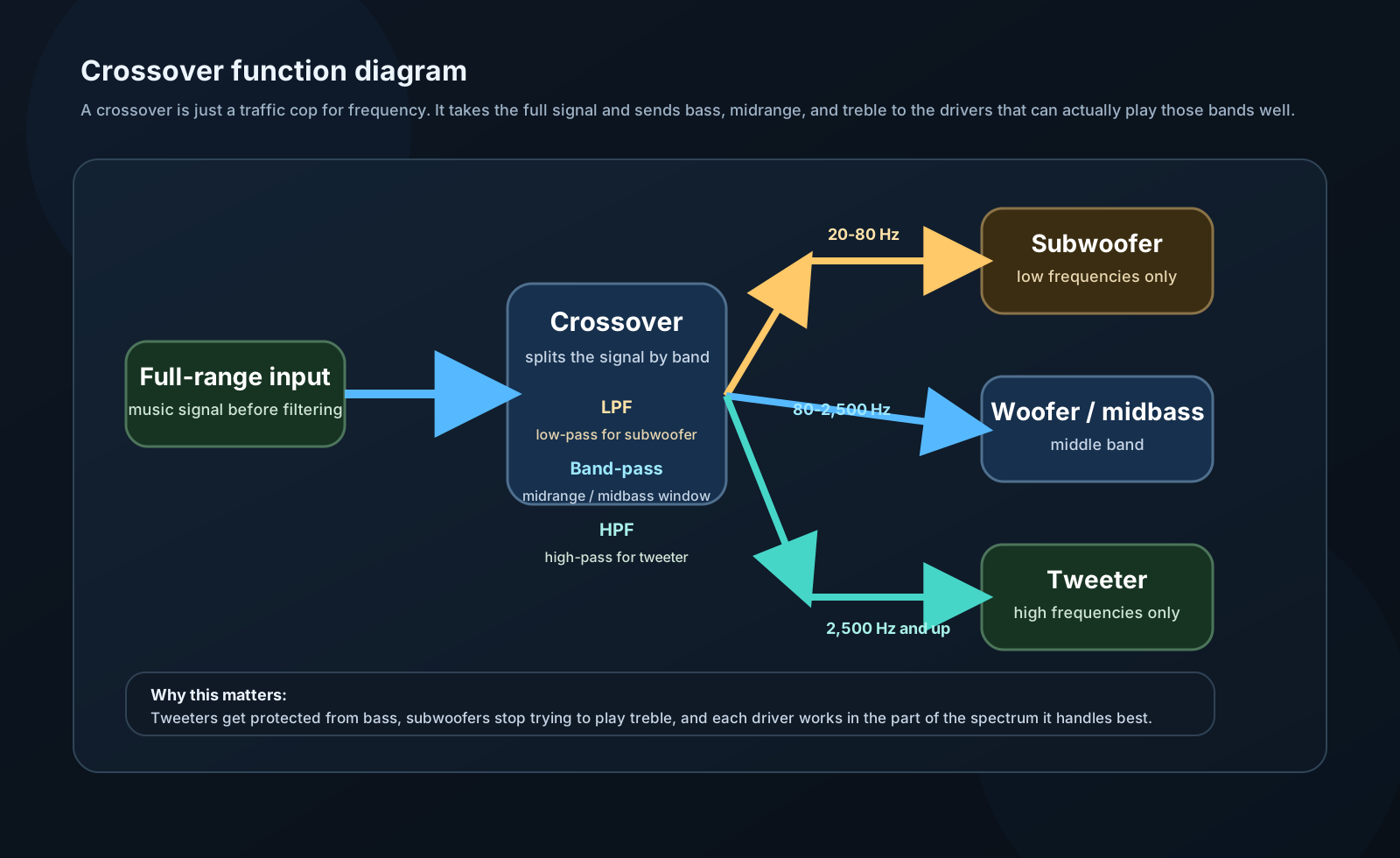
For a basic 2-way plus sub system, 80 Hz LR24 on the sub and front speakers is still one of the safest starting points. Then verify the handoff with listening or measurement before getting fancy.
A DSP crossover is a digital filter applied per output channel. Unlike passive crossovers (capacitors and inductors built into a box), DSP crossovers:
Setting up a basic 2-way + subwoofer system:
Why Linkwitz-Riley 24 dB/octave:
At the crossover frequency, both filters are at −6 dB. The sum is flat (0 dB). Both channels are in phase. No peaks, no dips, no polarity corrections needed. It's the professional standard for good reason.
A three-way active system needs: - Tweeter high-pass filter (HPF at crossover 1) - Midrange band-pass filter (HPF at crossover 2, LPF at crossover 1) - Midbass low-pass filter (LPF at crossover 2) - Subwoofer low-pass filter (LPF at crossover 3) - All driver high-pass filters (subsonic protection)
Selecting crossover frequencies:
Tweeter crossover (Crossover 1): Must be at least 2–3× the tweeter's Fs. For a tweeter with Fs = 900 Hz, minimum crossover is 1,800–2,700 Hz. Set at 2,500–3,500 Hz for most quality tweeters.
Midrange/Midbass crossover (Crossover 2): Depends on midbass capability. Typical 6.5" midbass reproduces to 500–600 Hz smoothly. Cross at 300–500 Hz.
Subwoofer crossover (Crossover 3): Standard 80 Hz for full-range fronts. 100–120 Hz if front speakers are small.
Example for quality 3-way + sub:
| Output | Filter | Frequency | Slope |
|---|---|---|---|
| Tweeter L/R | HPF | 3,000 Hz | LR24 |
| Midrange L/R | HPF | 300 Hz | LR24 |
| Midrange L/R | LPF | 3,000 Hz | LR24 |
| Midbass L/R | HPF | 80 Hz | LR24 |
| Midbass L/R | LPF | 300 Hz | LR24 |
| Subwoofer | HPF (subsonic) | 25 Hz | LR24 |
| Subwoofer | LPF | 80 Hz | LR24 |
Physical drivers don't have infinite bandwidth — they have natural acoustic rolloffs. A tweeter's response may already be falling at 2 kHz even without a crossover filter. The DSP filter combines with this natural rolloff:
H_total(f) = H_DSP_filter(f) × H_driver_response(f)
Why this matters:
If your tweeter is already −6 dB at 3 kHz due to its natural Fs rolloff, and you set your HPF at 3 kHz, the effective cutoff appears lower than intended — the natural rolloff and DSP filter compound.
Compensation: Set the DSP crossover slightly above where the natural rolloff begins. Measure the full system with crossover active to confirm actual acoustic crossover point. The measured −6 dB point (in an LR24 system) is what matters, not the filter setting alone.
Standard DSP crossovers in almost all consumer car audio DSPs use IIR (recursive) filters. These are the direct digital equivalents of analog filter circuits.
Properties: - Minimum phase — phase shift is tied to amplitude response - Computationally efficient (biquad sections: 5 multiply-accumulates per sample) - Any slope achievable with sufficient sections in series - Non-linear phase response — different frequencies arrive at different times
Linkwitz-Riley implementation:
LR4 = two cascaded Butterworth 2nd-order sections at same frequency. LR8 = two cascaded Butterworth 4th-order sections.
H_LR4(s) = H_BW2(s) × H_BW2(s)
At crossover frequency:
|H_HPF(-6dB)| + |H_LPF(-6dB)| = flat (both 0.5, sum = 1.0 in linear)
Phase: HPF = −360°, LPF = −360° (identical, in phase)
The phase problem:
Below and above crossover, IIR filter phase rotates differently for different filter orders. A perfect LR4 crossover is flat in magnitude AND phase at the crossover frequency, but the phase of each individual path rotates through several hundred degrees across the full bandwidth.
This means an impulse played through an LR4-crossed system does not arrive with perfect timing at all frequencies — different frequencies in the tweeter range arrive slightly after different frequencies in the midrange range.
For most music listening this is inaudible. For critical SQ competition, this is why FIR crossovers exist.
FIR filters can achieve linear phase — all frequencies in the passband are delayed by exactly the same amount (constant group delay).
Linear phase HPF implementation:
h[n] = δ[n - N/2] - h_LPF[n] (spectral subtraction)
Where h_LPF[n] is a linear-phase lowpass FIR.
Key properties: - All frequencies delayed equally (constant group delay = N/2 samples) - No pre-ringing in minimum-phase sense — but has symmetric pre- and post-ringing (inherent to linear phase filters) - Computationally expensive: N multiply-accumulates per sample, N typically 256–8192 for audio crossovers - Latency: N/2 samples at sample rate → at N=4096, 48kHz: 42.7ms latency per filter
DSP FIR support:
At 48 kHz, a 4096-tap FIR provides 42.7ms of group delay (latency). All channels must be delayed equally to maintain coherence — the non-FIR channels receive a matching time delay.
Platforms supporting FIR: miniDSP C-DSP 8×12 DL, Helix DSP Pro MK3, Alpine Bit One HD.