
13.1 SPL Competition Engineering
🔰 BEGINNER LEVEL: What SPL Competition Is
Understanding dB Drag Racing
SPL (Sound Pressure Level) competition is simple in concept: play a test tone, measure peak SPL with a calibrated meter, highest number wins. The execution, however, is extraordinarily complex engineering.
The format:
- Test frequency: Typically 40 Hz, 50 Hz, or 63 Hz (organization-specific)
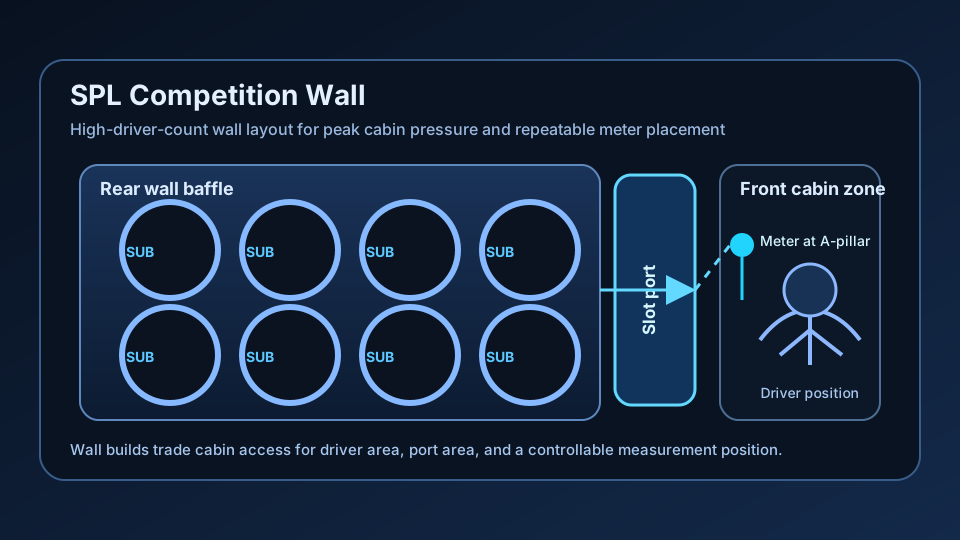
- Measurement device: TermLab meter positioned at driver's A-pillar
- Duration: 30 seconds maximum for measurement (many competitors "burp" for 10-15 seconds)
- Vehicle condition: Windows and doors closed, vents sealed
- Classes: Organized by vehicle type, power level, driver position, and other factors
What makes it extreme:
Championship SPL vehicles produce 170+ dB — louder than a jet engine at takeoff (140 dB), louder than a gunshot (160 dB). These levels require:
- 10,000–100,000+ watts of amplifier power
- 4–24+ subwoofer drivers in a wall configuration
- Massive electrical systems (multiple alternators, battery banks)
- Significant vehicle structural modifications
Why People Compete
Not for music listening. A vehicle optimized for 170 dB at 50 Hz sounds terrible with actual music. These are purpose-built demonstration machines.
Motivations: - Engineering challenge (pushing physical limits) - Community and camaraderie (tight-knit competition scene) - Brand representation (sponsored competitors) - Bragging rights (world record holders)
Entry-level SPL (140–150 dB range) is achievable with $3,000–5,000 and moderate modifications. This is where most hobbyists start.
Championship SPL (165+ dB) requires $20,000–150,000+ in equipment and extensive fabrication. This is professional-level commitment.
🔧 INSTALLER LEVEL: Building for Maximum Output
The Physics of SPL
Cabin pressure maximization is the goal. Below the cabin's first resonant mode (~40 Hz for typical sedans), the interior behaves as a sealed pressure vessel. All acoustic output from drivers pressurizes this volume.
Key equation — maximum SPL from displacement:
SPL_max = 112 + 20×log₁₀(Sd × Xmax × N) + 10×log₁₀(f²) - 20×log₁₀(V_cabin^(1/3))
Where: - Sd = effective piston area per driver (m²) - Xmax = linear excursion (m) - N = number of drivers - f = frequency (Hz) - V_cabin = cabin volume (m³)
Breaking this down:
More drivers → more SPL (logarithmic)
More excursion per driver → more SPL (logarithmic)
Higher frequency → more SPL (squared)
Smaller cabin → more SPL (inverse relationship)
Practical implications:
Driver count matters most — 12 drivers produce +10.8 dB over 1 driver (20×log₁₀(12) = 21.6 dB, but divided by 2 for acoustic impedance effects)
Excursion is expensive — Doubling Xmax from 15mm to 30mm = +6 dB, but drivers with 30mm Xmax cost 2-3× more
Frequency selection — 63 Hz produces +4 dB over 40 Hz for same displacement (10×log₁₀(63²/40²) = 3.9 dB). This is why some organizations use higher test frequencies.
Cabin size — Smaller vehicles have natural advantage. A compact car produces ~3 dB more SPL than a full-size SUV with identical systems.

Component Selection for SPL
Subwoofer criteria:
- High Xmax: 25mm+ (competition drivers reach 50mm+)
- High sensitivity: 90+ dB/W/m
- High power handling: 2000W+ RMS per driver
- Low Qts: 0.25–0.40 (for bandpass or large ported enclosures)
- Robust construction: Reinforced voice coil former, vented pole piece
Example competition drivers:
- Sundown Audio Z v5 15" — Xmax 32mm, 2500W, Qts 0.32, $700
- DC Audio Level 5 15" — Xmax 38mm, 3500W, Qts 0.35, $550
- Fi Audio BTL 18" — Xmax 34mm, 5000W, Qts 0.38, $1200
- Crescendo Audio Forte 18" — Xmax 40mm, 3000W, Qts 0.33, $800
Amplifier criteria:
- Stable to 0.5Ω or lower (parallel wiring many drivers)
- High current output (not just watts — current delivery matters)
- Competition-grade build (thermal management for burping)
- Compact form factor (need to fit many amps)
Popular competition amplifier brands:
- Taramps (Brazilian brand, extreme power density)
- Sundown Audio (SAZ/SCV series)
- DC Audio (competition monoblocks)
- American Bass (VFL series)
Power ratings: Competition amps are often rated honestly. A "10,000W" competition amp actually produces 10,000W RMS at rated impedance with adequate voltage.
Enclosure Strategies
Three main approaches:
1. Ported (most common for street classes):
- Large volume (8–15 ft³ per driver typical)
- Tuned precisely to test frequency ±2 Hz
- Slot port or multiple round ports
- Provides high efficiency at tuning frequency
2. Bandpass (maximum output, narrow bandwidth):
- 4th or 6th order bandpass
- Tuned to exact test frequency
- 6–12 dB more output than ported at peak
- Useless for music (extremely narrow passband)
3. Infinite baffle / free air (rare in SPL, common in SQL):
- Drivers fire through a sealed baffle into trunk
- Trunk volume acts as "infinite" rear chamber
- Requires very low Qts drivers
- Good efficiency but less peak output than bandpass
Competition enclosure construction:
- MDF thickness: 1.5" to 2" (rigidity critical)
- Bracing: Extensive — every panel
- Port velocity: Design for 50+ m/s (with flares, this is achievable without chuffing)
- Alignment to cabin: Wall positioned to excite cabin modes favorably
⚙️ ENGINEER LEVEL: Acoustic Optimization Theory
Cabin Transfer Function Modeling
The vehicle cabin is not a rigid piston but a complex resonant cavity. The transfer function from driver volume velocity to cabin pressure involves:
Modal analysis — each cabin dimension supports standing wave modes:
f_lmn = (c/2) × √[(l/Lx)² + (m/Ly)² + (n/Lz)²]
For a sedan (Lx=1.2m, Ly=1.5m, Lz=4.0m interior dimensions):
f_100 = (343/2) × (1/1.2) = 143 Hz (width mode)
f_010 = (343/2) × (1/1.5) = 114 Hz (height mode)
f_001 = (343/2) × (1/4.0) = 43 Hz (length mode)
At 40-50 Hz, the wavelength (7-8.5m) is longer than cabin length. The cabin pressurizes uniformly — this is ideal for SPL. No nodes or antinodes to worry about. Pure pressure gain.
Cabin gain formula (simplified for low frequencies):
G_cabin = 10 × log₁₀[(4π × V_cabin) / λ²]
At 50 Hz, λ = 6.86m, V_cabin = 3 m³:
G_cabin = 10 × log₁₀[(4π × 3) / 6.86²] = 10 × log₁₀(0.801) = -0.96 dB
Wait, that's a loss, not gain. Let me reconsider the cabin gain model.
Correct approach — pressure doubling from boundary loading:
In a sealed cabin at frequencies well below first mode, pressure increases because the air cannot escape. The effective radiation impedance seen by the driver increases, causing more mechanical-to-acoustic power conversion.
Practical cabin gain: 10–20 dB depending on vehicle size and sealing quality. Smaller, well-sealed vehicles exhibit more gain.
Thermal Power Compression in Competition
Voice coil temperature during burping:
Assume 15-second burp at 10,000W into a driver with Re = 1Ω (cold).
Power dissipation in voice coil:
P_heat = I² × Re = (√(10000/1))² × 1 = 10,000W
All 10,000W becomes heat in the voice coil (100% conversion to thermal at DC and low frequencies).
Temperature rise (using thermal mass of typical 3" voice coil):
Thermal mass ≈ 50 J/°C (aluminum former, copper wire)
ΔT = (P × t) / C_thermal = (10000 × 15) / 50 = 3000°C theoretical
Obviously impossible — the coil would vaporize. What actually happens:
- Voice coil heats rapidly to 300-500°C
- Resistance increases (Rhot = Rcold × [1 + α×ΔT])
- Current decreases for same voltage
- Power decreases (power compression)
- After ~5-10 seconds, thermal equilibrium at reduced power
Competition strategy: Burp duration kept under 15 seconds. Cooling between runs (forced air, liquid cooling on extreme builds).
Liquid-cooled voice coils (exotic competition tech):
Some championship builds use subwoofers with hollow voice coil formers. Coolant (water or glycol) circulates through the former, removing heat directly. Allows sustained high power. Adds complexity and cost.